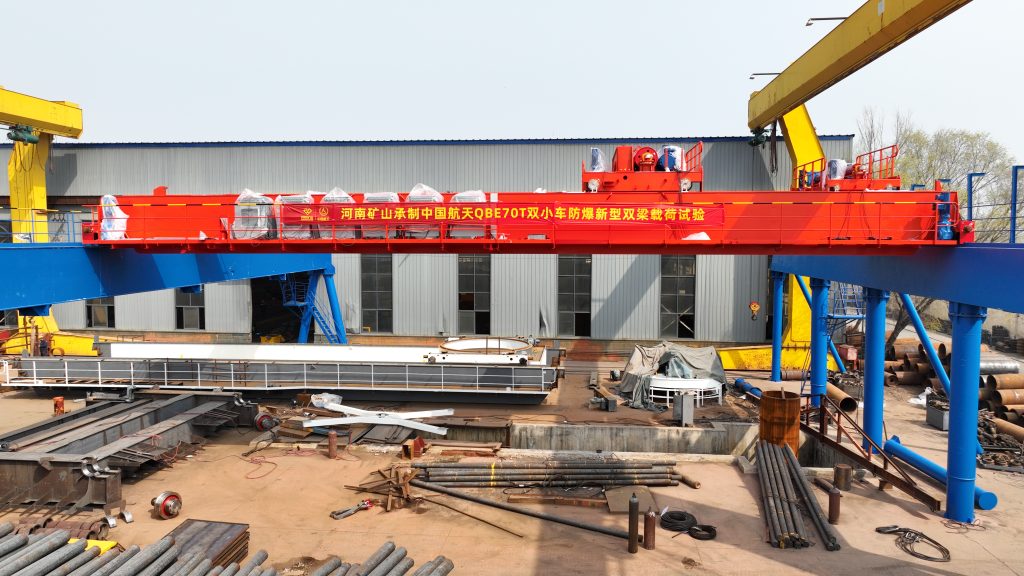
Where it is used
Long fabricated components
Support beams, shafts or frames at two lifting points using an approved load-sharing arrangement.
Machinery assembly
Use separate hooks for component positioning and controlled alignment during assembly.
Equipment maintenance
Handle large rollers or machinery parts with lifting points spaced along the load.
Product features
Independent trolley operation
Each trolley can serve an individual lifting task within the approved crane loading limits. Each trolley rating and permitted combined operation are defined separately in the approved load chart.
Coordinated handling
The selected control arrangement can coordinate hoisting and travel for an engineered lifting procedure.
Flexible lifting points
Trolley spacing can be adjusted to suit the workpiece and rigging geometry.
Technical specifications
Model: KSQE
| Model | KSQE |
|---|---|
| Trolley arrangement | Two independent trolleys sharing the bridge track |
| Operating modes | Individual or coordinated operation within approved load limits |
| Bridge construction | Segmented bridge with bolted main-girder/end-carriage connections |
| Motion control | Variable-speed travel and precise low-speed positioning |
| Protection functions | Overload, travel-limit and emergency-stop functions |
| Published KSQE per-trolley capacity options | 2, 3, 5, 10 or 16 t per trolley |
| Published KSQE workshop span | Approx. 10.5–31.5 m |
| Published KSQE working-duty options | A3, A4 or A5 |
Published selection ranges are configuration dependent. Rated load, span, height, speed and duty are confirmed together in the project drawing.
Price guide
Request a configuration-specific price for this crane. The quotation is based on the lifting task, site dimensions and the equipment scope below.
What affects the price?
- Rated load, lifting attachment and duty cycle
- Bridge span, lifting height and runway length
- Motion controls, electrical supply and destination requirements
- Freight, runway structure, installation and commissioning scope
Typical configurations
Lifting arrangement
Two hook trolleys
Define independent tasks, tandem lifts and the governing reaction at each lifting point.
Motion control
Stepless speed control with micro-speed positioning
Specify transfer speed and fine-placement requirements for the load.
Bridge construction
Segmented bridge with bolted main and end girders
Coordinate installation and maintenance access with the workshop layout.
Final capacity, dimensions and operating functions are agreed for your load and site.
Related project experience

Related two-point lifting project
Two-point lifting for wind-turbine assembly
- 500t-class double-trolley, double-girder installation.
- Synchronized hooks and electrical anti-sway.
- Digital and video monitoring for assembly handling.
This heavy-duty installation illustrates two-point handling. Its hook ratings and hoisting mechanisms are specific to that project; your crane is selected around the load, lifting points and approved lifting sequence.
View project detailsCompare related models
Compare the lifting arrangement and site layout before choosing a model.
Configuration
Conventional industrial double-trolley platform for independent or coordinated two-point lifting without the KSQE modular low-headroom concept as the primary design feature.
Consider it when
Two trolley lifting positions are required, while conventional bridge construction and motion control satisfy the operating process.
Configuration
Adds a third trolley lifting station for several dedicated process or maintenance positions on one bridge.
Consider it when
Three separate lifting stations provide a process advantage, particularly for paper-machine or maintenance-intensive production lines.
Configuration
Uses one primary trolley while retaining the modern low-headroom, micro-speed, anti-sway and modular design concept.
Consider it when
The load can be handled from one hook position and there is no regular requirement for tandem lifting.
Plan your crane specification
Provide maximum complete load, individual trolley reactions, load dimensions, centre of gravity and lifting-point spacing. Include the rigging and lifting beam, any independent trolley tasks and the required turning sequence.
Send the workshop layout, runway dimensions, hook elevations, roof restrictions and required side approaches. Identify transport dimensions, delivery access and erection constraints relevant to the segmented bridge.
State cycle frequency, shifts, transfer distances and positioning requirements. Add power supply, operator-control preference and process interfaces so the crane's mechanical arrangement and optional control functions can be coordinated with the assembly operation.
Frequently asked questions
Can the KSQE turn a large component?
Turning can be planned with coordinated trolley operation when load geometry, reaction changes and clearances are defined. Supply the complete sequence and permissible inclination for assessment.
Are the two trolley ratings always equal?
No. Each rating follows the maximum calculated reaction and any independent lifting task. Include centre of gravity and rigging geometry so load distribution can be established.
Does the segmented bridge remove erection planning?
No. It supports transport and site assembly, but section sizes, lifting access, connection work and the building layout still need to be coordinated with the installation plan.
Product views and components