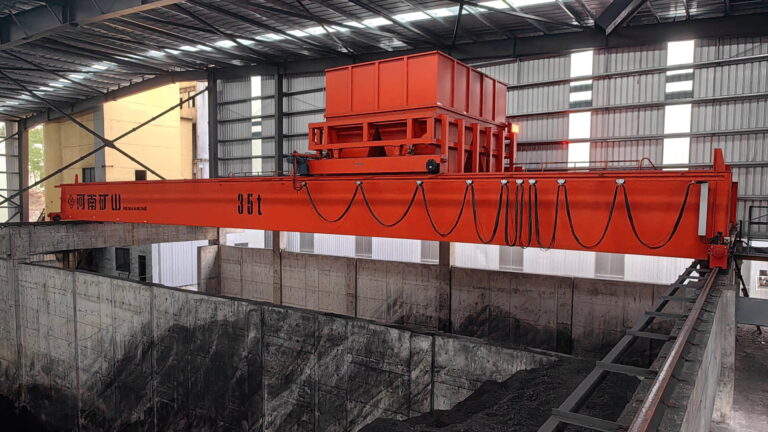
Offshore Wind Manufacturing Crane Project
A 500t-class heavy-duty overhead crane engineered for synchronized lifting, controlled turning and precision assembly of large offshore wind components.

500t-class double-trolley overhead crane installed in an offshore wind component manufacturing workshop.
| ApplicationOffshore wind component manufacturing | Crane TypeDouble-trolley, double-girder overhead crane | Heavy Crane Marking500(500+250/32)t | Control PackageSynchronization, anti-sway and monitoring |
Project Background
This offshore wind manufacturing project required a heavy lifting system for large nacelles, generators, mainframes, production fixtures and other high-value wind turbine components. The components move through unloading, assembly, turning, transfer and installation processes inside a large production workshop.
Henan Mine Crane supplied a 500t-class double-trolley, double-girder overhead crane as part of the Phase I lifting package. The phase included 43 crane sets serving different workstations, allowing the plant to combine very high-capacity assembly lifting with supporting production and maintenance duties.
The 500t crane uses high-lift lightweight hoisting, automatic fast/slow speed adjustment, high-precision multi-hook synchronization, electrical anti-sway and digital/video monitoring. These functions address the two priorities that matter most in wind turbine production: moving extremely heavy components efficiently and positioning them accurately at the assembly station.
Planning a similar crane? Send the heaviest component weight, rigging weight, lifting-point drawing, center of gravity, allowable tilt, workshop span, lifting height, hook approach, duty cycle and positioning tolerance to receive a project-specific technical proposal and quotation.
Customer Lifting Requirements
Offshore wind components combine high weight, large dimensions and concentrated lifting points. A nacelle or generator assembly may also have an offset center of gravity, so the crane must control individual lifting points and maintain the required load attitude throughout the lift.
The production process needs more than maximum capacity. Long transfers favor efficient travel speeds, while final assembly requires stable low-speed motion. High lifting height is necessary to clear tooling and production equipment, but longer suspended ropes can increase sway.
The workshop structure and crane must be engineered together. Bridge self-weight, maximum wheel loads, runway elevation, building headroom, side approach, end approach and maintenance access all influence the final crane arrangement and facility cost.
Because Phase I included a large crane fleet, the project also required consistent control architecture, monitoring, fault records and lifecycle maintenance planning across different capacities and work areas.
500t Double-Trolley Crane Solution
The project crane adopts a double-girder bridge with two trolley systems. This configuration provides a strong structural platform for high-capacity lifting and allows multiple hooks to work independently or in coordinated modes according to the component and approved lifting procedure.
The crane marking shown on the installed equipment is 500(500+250/32)t. The hook arrangement supports heavy main lifting, distributed lifting points and auxiliary handling for turning or assembly tasks. Each operating combination is defined by the control logic so the crane remains within the permitted load condition.
For a new project, trolley spacing, hook capacities, hook approaches and combined lifting modes are matched to the buyer’s component drawings. Buyers can compare available double-girder overhead crane configurations and review offshore engineering crane applications before issuing the final RFQ.
High-Lift Lightweight Hoisting
A lightweight hoisting arrangement reduces unnecessary trolley and mechanism mass while maintaining the required high lifting height and heavy-duty performance. Lower moving mass can reduce bridge and runway reactions and can improve motion response during precision positioning.
The required lift is calculated from the lowest pickup level, highest assembly position, lifting beam height, sling length and clearance above production equipment. Drum capacity, rope reeving, sheave arrangement and hook block dimensions are then selected around the actual lift path.
The final design still follows the operating duty. Structural fatigue, motor sizing, gearbox selection, brakes, wire ropes, sheaves and maintenance access are based on load spectrum, operating hours and production cycles rather than capacity alone.
Multi-Hook Synchronization for Balanced Lifting
High-precision synchronization coordinates the participating hooks so the component remains level or follows a controlled tilt. Position and operating feedback allow the control system to correct deviation and maintain balanced motion during lifting and lowering.
The permissible hook difference is determined by the component structure, lifting points and assembly tolerance. Alarm, speed-reduction and stopping thresholds can be configured for excessive position difference, unequal load, sensor inconsistency or communication failure.
For controlled turning, the lifting procedure defines which trolley or hook leads, the required relative height and the load share at every stage. Mode selection and interlocks prevent incompatible commands during synchronized operation.
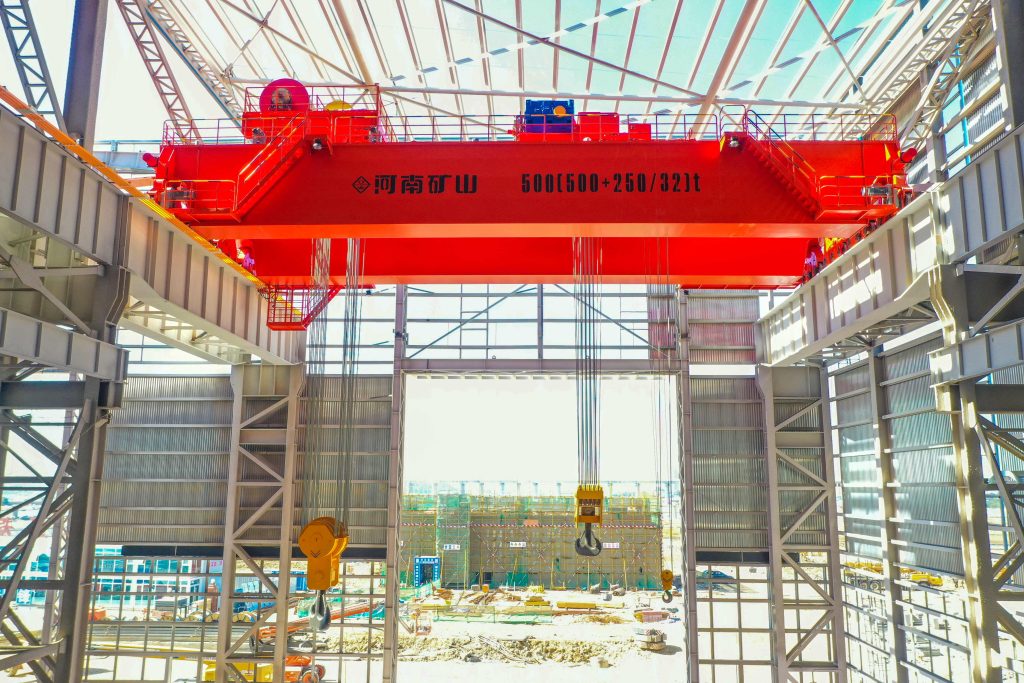
Multiple hook blocks support component-specific lifting and assembly modes. |
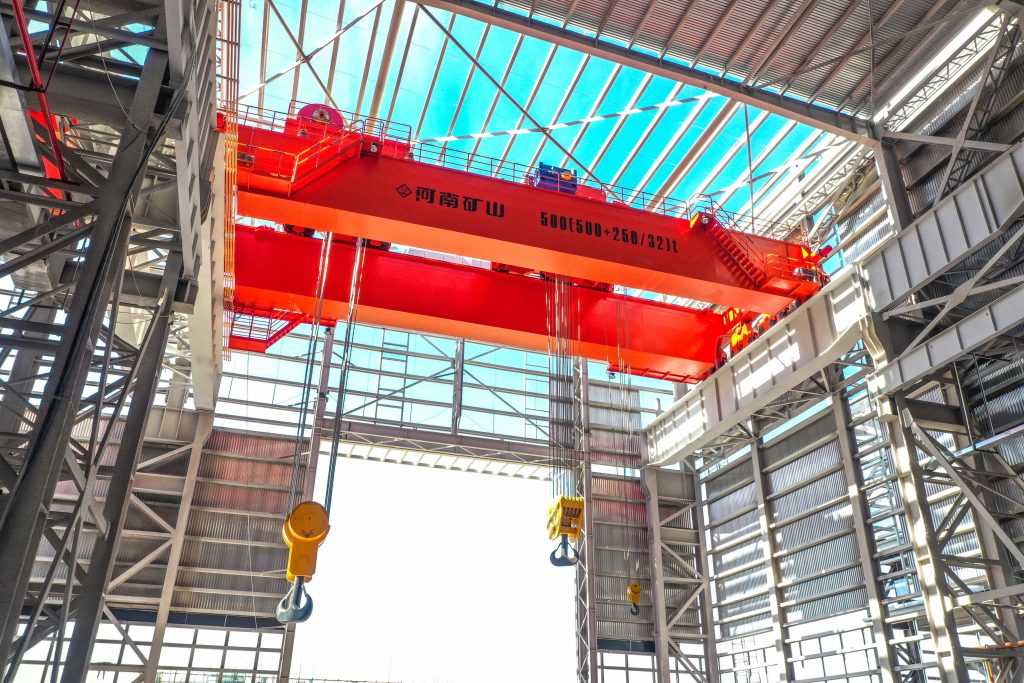
Double-girder structure and trolley arrangement for heavy offshore wind component handling. |
Automatic Fast and Slow Speed Control
Automatic fast/slow speed adjustment supports both production efficiency and assembly accuracy. The crane can use a faster profile for general movement and change to controlled low speed as the component approaches a workstation, fixture or installation position.
Acceleration and deceleration are tuned to load weight, rope length and travel distance. Smooth transitions reduce dynamic loading and help the anti-sway function stabilize the suspended component.
Procurement specifications should state maximum speeds, minimum controllable speed, acceleration time, positioning tolerance and the operating conditions for each speed range. These values provide a clearer performance target than travel speed alone.
Electrical Anti-Sway and Precision Positioning
Electrical anti-sway control reduces load oscillation during bridge and trolley movement. Stable components can enter the assembly zone sooner, reducing corrective movements and helping operators protect high-value equipment.
Anti-sway performance is coordinated with speed profiles, acceleration, rope length and load geometry. Commissioning tests use representative lifting conditions so the system responds correctly to large wind turbine components rather than only compact test loads.
The crane can also be configured with position measurement, load display and operating limits for repeatable workstation approaches. The required positioning accuracy should be stated in the buyer’s technical schedule.
Digital and Video Monitoring
Digital monitoring records operating status, running hours, lifting events, alarms and mechanism conditions. Video monitoring improves visibility around hook approaches, blind areas and large components during lifting and transfer.
The monitoring package supports maintenance planning across the Phase I fleet. Common fault records, operating data and condition information help the maintenance team schedule inspections and identify recurring issues before they affect production.
Camera locations, display layout, data retention and plant-network interfaces can be selected for the buyer’s operating and cybersecurity requirements. The system can form part of a broader lifecycle management plan for the crane fleet.
Workshop and Runway Coordination
A 500t offshore wind overhead crane must be coordinated with the building from the beginning of the project. The crane general arrangement defines span, runway elevation, bridge and trolley dimensions, hook approaches, maintenance clearances, conductor system and end buffers.
Maximum and fatigue wheel loads, horizontal forces and runway tolerances are supplied for review by the building designer. Early coordination can prevent expensive changes to columns, runway beams or roof structures after fabrication begins.
For coastal manufacturing locations, the buyer should define humidity, airborne salt exposure, indoor temperature, dust, paint system and electrical enclosure requirements. The crane can then be protected for the actual workshop environment.
Safety, Testing and Commissioning
The control package includes operating limits, overload protection, coordinated stopping logic and fault handling for synchronized lifting. The safety plan also defines restricted work zones, command ownership, communication and recovery after power loss or sensor faults.
Factory and site testing cover the structure, hoisting mechanisms, brakes, limits, speed control, hook synchronization, anti-sway, monitoring and emergency functions. Load tests confirm the approved independent and combined lifting modes.
Commissioning includes production simulation with representative rigging and lifting steps. Operator and maintenance training covers normal control, synchronized modes, alarms, inspection points, fault recovery and routine maintenance.
Key Project Configuration
| Project Element | Installed Project Configuration |
|---|---|
| Industry | Offshore wind component manufacturing and assembly. |
| Project Phase | Phase I crane package with 43 crane sets. |
| Main Crane | 500t-class double-trolley, double-girder overhead crane. |
| Crane Marking | 500(500+250/32)t shown on the installed crane. |
| Typical Loads | Large nacelles, generators, mainframes, wind turbine components and production fixtures. |
| Hoisting | High-lift lightweight hoisting design. |
| Motion Control | Automatic fast/slow speed adjustment and high-precision multi-hook synchronization. |
| Load Stability | Electrical anti-sway for controlled component transfer and positioning. |
| Monitoring | Digital status, video monitoring and lifecycle management. |
Project Result
The 500t double-trolley overhead crane gives the offshore wind plant dedicated capacity for its heaviest component handling and assembly operations. Multiple hooks support distributed lifting points, balanced transfer and controlled turning procedures.
High-lift lightweight hoisting provides the required working envelope, while automatic fast/slow speed control supports both efficient transfer and precise final positioning. Electrical anti-sway and hook synchronization improve control of large, high-value loads.
Digital and video monitoring add operating visibility and support maintenance across the 43-crane Phase I package. The project demonstrates how a flagship 500t crane can be integrated into a coordinated lifting fleet for large-scale wind turbine production.
Explore the related offshore wind assembly crane solution or browse more industrial overhead crane options for a new manufacturing facility.
Information Required for a 500t Offshore Wind Crane Quote
Send the following information so Henan Mine Crane can prepare a technical proposal and commercial quotation for your lifting process:
| Component Data Maximum and typical weights, dimensions, lifting points, center of gravity, rigging weight, allowable tilt and future turbine models |
Workshop Layout Span, runway length, lifting height, runway elevation, headroom, hook approaches, maintenance zones and building load limits |
Lifting Process Trolley modes, synchronized lifting points, turning sequence, lifting beam, assembly stations and positioning tolerance |
| Performance Duty class, annual lifts, operating hours, high and low speeds, acceleration time, production cycle and availability target |
Control and Safety Synchronization tolerance, anti-sway, load measurement, cameras, monitoring, plant interfaces and required standards |
Commercial Scope Crane quantity, delivery destination, installation, commissioning, testing, training, spare parts, warranty and lifecycle service |
Frequently Asked Questions
Why use a double-trolley crane for offshore wind manufacturing?
Two trolleys provide flexible lifting-point spacing, distributed load handling and coordinated motion for large nacelles, generators and mainframe structures. The arrangement can also support controlled turning and auxiliary handling modes.
Does every wind turbine factory require a 500t overhead crane?
No. Required capacity is calculated from the heaviest component, rigging and lifting-beam weight, dynamic effects, lifting procedure and planned future product range. Some workstations may require smaller supporting cranes.
Can the hooks operate independently and synchronously?
Yes. Operating modes can allow independent handling for suitable tasks and synchronized control for approved multi-point lifts. Capacity limits and interlocks are configured for each mode.
How is sway controlled during long component transfers?
Electrical anti-sway coordinates bridge and trolley acceleration with the suspended load. Performance is tuned to rope length, speed range, load geometry and representative operating conditions.
Is this crane installed offshore at sea?
This project is an overhead crane for an onshore offshore-wind component manufacturing workshop. Vessel, quay and offshore-platform cranes require a different structural and environmental design basis.
What information is needed before pricing?
Provide component and lifting-point drawings, rigging data, capacity, span, lift, hook approach, trolley modes, synchronization tolerance, speeds, duty, workshop environment, standards and service scope.
Request a 500t Offshore Wind Crane Quote
Send your component drawings, lifting points, rigging plan, workshop layout, trolley operating modes, synchronization accuracy and duty requirements. Henan Mine Crane will prepare a customized technical proposal and commercial quotation.