








International Inland Port RMG Project
A customized rail-mounted container gantry crane with Siemens PLC, full variable-frequency control, anti-sway, a ring trolley and interchangeable upper/lower spreader frames.
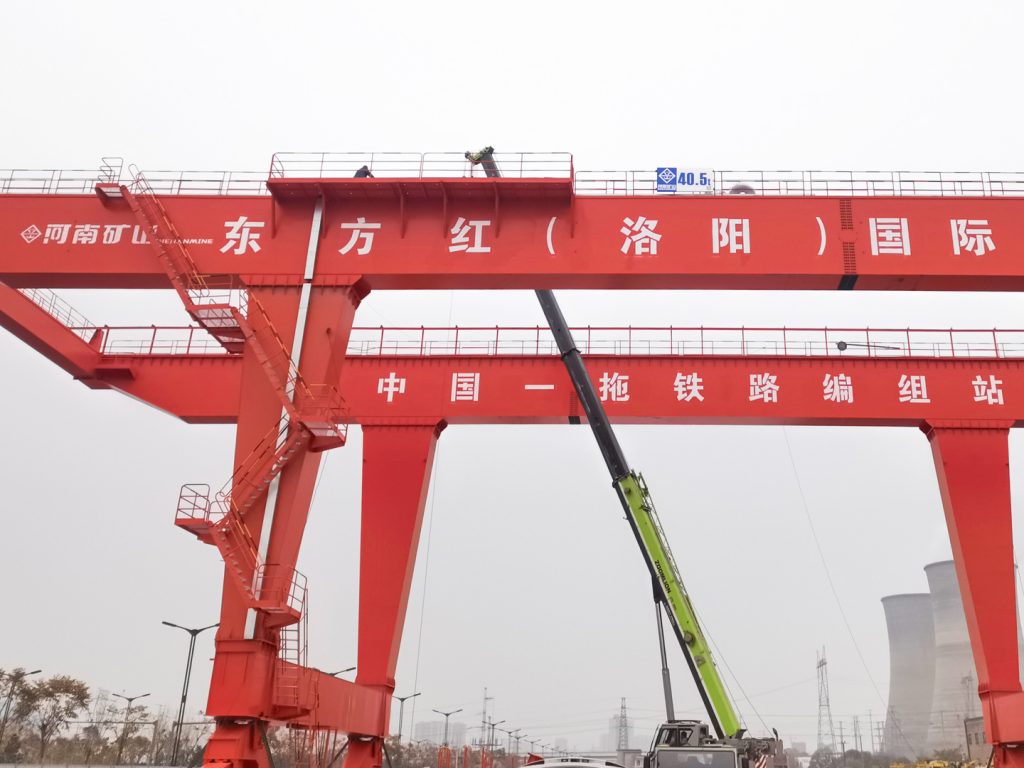
40.5t rail-mounted container gantry crane installed at Dongfanghong (Luoyang) International Inland Port.
| ProjectLuoyang International Inland Port | Capacity Marking40.5t | ControlFull VFD + Siemens PLC | HandlingAnti-sway + interchangeable spreader |
Project Background
Henan Mine Crane supplied a customized rail-mounted container gantry crane to Dongfanghong (Luoyang) International Inland Port. The terminal supports international and domestic rail logistics, road transfer and container-yard operations, requiring dependable handling above a permanent intermodal block.
The project crane carries a 40.5t capacity marking and uses full variable-frequency speed control with a Siemens PLC. Anti-sway control improves container stability during transfer, while a ring trolley accommodates the project’s complex lifting positions.
An interchangeable upper/lower-frame spreader arrangement allows the lifting interface to be changed for different handling requirements. The project therefore provides a practical reference for buyers who need an inland-port RMG that combines repetitive container service with attachment flexibility.
Procurement priority: Provide rated capacity under the spreader, container and cargo types, rail gauge, span, lifting height, runway length, stack rows, railway and truck lanes, target moves per hour, duty class, attachment-change requirements and control interfaces before requesting an RMG quotation.
The International Inland Port Challenge
International inland ports coordinate cross-border rail services, domestic trains, road vehicles, customs-related processes and container storage. The RMG block must keep containers moving without becoming a bottleneck between arrival, stacking and onward dispatch.
The crane repeatedly aligns its spreader with containers on railway wagons, trucks and storage stacks. Long trolley travel, changing lift height and wind can create container sway that delays final positioning.
The yard may also contain different handling positions or cargo interfaces. A standard trolley and permanently fixed spreader may not give the required flexibility, so the hoisting arrangement and attachment connection must be engineered together with the terminal layout.
Long-term inland-port service adds high cycle demand. Crane structure, hoisting, trolley, long travel, ropes, brakes, controls and maintenance access must be selected from actual utilization rather than rated load alone.
40.5t Rail-Mounted Gantry Crane Solution
The project uses an RMG crane running on fixed rails above the inland-port container block. Rail-guided travel provides a defined operating path, supports repeatable positioning and makes efficient use of permanent railway and stack areas.
The 40.5t marking identifies the referenced project configuration. For a new crane, rated capacity should be stated under the spreader and verified against maximum container gross weight, spreader self-weight, single- or twin-lift operation and special cargo attachments.
Span is selected from railway tracks, road lanes and container rows. Lifting height includes the highest working position, container height, spreader geometry and safe vertical clearance. Cantilevers can be configured where transfer outside the main rail span is required.
Review Henan Mine Crane’s RMG crane configurations and port and intermodal crane applications before preparing a project-specific technical schedule.
Full Variable-Frequency Motion Control
Full VFD control manages the crane’s primary mechanisms with controlled acceleration, deceleration and low-speed approach. Smooth speed changes reduce mechanical shock and help stabilize repetitive container movements.
The crane can use higher speed over the main movement distance, then decelerate for final alignment above a wagon, truck or stack. The operating profile is coordinated with anti-sway control and position signals.
A buyer should define required hoisting, trolley and crane travel speeds, acceleration times, braking method, power supply, ambient conditions and energy-feedback requirements. Installed motor power alone does not show cycle productivity or energy consumption.
Siemens PLC Control Platform
The Siemens PLC coordinates mechanism commands, operating modes, position information, interlocks and alarm status. It provides the central control logic connecting drives, sensors, safety devices and the spreader system.
For a new inland port, the PLC can exchange task and status information with a terminal or yard-management system when required. Interface documents should define signals, protocols, command ownership, task confirmation, alarm behavior and response to communication loss.
Diagnostics should identify the mechanism, condition and sequence step causing an interruption. Clear event records help maintenance teams distinguish equipment faults from unavailable targets, incorrect cargo data or external terminal delays.
Anti-Sway Container Handling
Anti-sway control reduces container oscillation during trolley travel and after deceleration. A more stable load can approach the target position sooner and requires fewer corrective movements before placement.
Performance depends on rope length, travel profile, container weight, wind and the selected control method. The final control parameters are tuned during commissioning with representative operating conditions.
Acceptance testing should cover loaded movement, different lifting heights, approach directions and target positions. Anti-sway assists accurate handling but does not replace safe operating limits or correct spreader engagement.
Ring Trolley for Complex Lifting Positions
A ring trolley is used as the hoisting mechanism on the Luoyang project crane. The arrangement was selected to accommodate the project’s complex lifting positions and forms part of the complete structural, reeving and spreader design.
Trolley engineering considers rated load, lifting height, mechanism speeds, rope arrangement, wheel loads, attachment geometry and maintenance access. The trolley’s position range must cover every approved rail, truck and stack target.
Inspection platforms and safe access routes should reach brakes, drums, ropes, sheaves, motors, gearboxes and sensors. Serviceability matters in high-utilization terminals where a long maintenance shutdown can interrupt the entire container block.
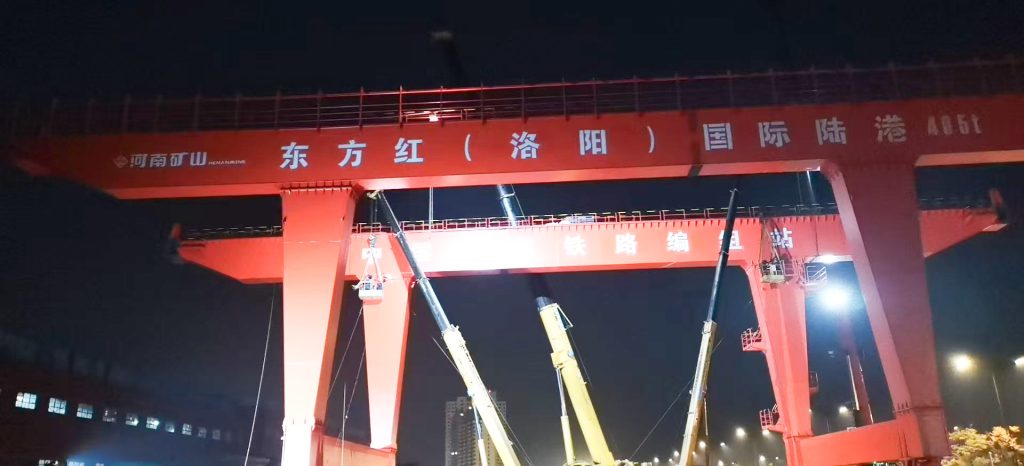
Night assembly and installation of the RMG structure at the Luoyang international inland-port project.
Interchangeable Upper and Lower Spreader Frames
The project uses an interchangeable upper/lower-frame spreader structure. Instead of limiting the crane to one permanent lifting interface, the terminal can change the approved lower arrangement for different container or cargo-handling tasks.
A buyer should identify container sizes, single- or twin-lift requirements, special frames, non-container cargo and expected changeover frequency. Attachment weight, center of gravity and height affect crane capacity, headroom and control settings.
Each interchangeable frame needs defined mechanical locking, electrical or hydraulic connections, identity confirmation and permissible operating modes. The crane should prevent lifting until the selected attachment is correctly connected and recognized.
Changeover procedures also affect productivity. Required support stands, storage positions, tools, inspection steps and authorized personnel should be included in the project scope.
Rail, Truck and Stack Interface
The RMG operating envelope must cover railway wagons, vehicle lanes and container stacks without interference. Yard drawings should show rail centerlines, wagon and truck profiles, stack rows, clearances, end approaches and adjacent equipment.
Container placement over rail wagons requires alignment with different train positions and wagon interfaces. Truck handling needs lane markings, vehicle-position requirements, driver signals and protected zones.
Stack allocation affects travel distance and re-handling. The terminal operating plan should coordinate crane tasks with train schedules, truck appointments and container retrieval priorities.
RMG or RTG for an Inland Port?
An RMG follows fixed rails and is well suited to permanent container blocks where predictable travel, high utilization and repeatable stacking are priorities. Rail guidance also supports clear electrical and control-system integration.
An RTG runs on rubber tires and can move between blocks, offering more routing flexibility. That mobility may be valuable in a changing yard, but it also changes power, steering, traffic and maintenance requirements.
The best choice follows the block layout, expected utilization, expansion plan and operating strategy. Use the RTG versus RMG buyer’s guide before finalizing the terminal concept.
Throughput and Duty Selection
The buyer should define target moves per hour, peak shift demand, annual cycles, load spectrum, operating days and expected availability. These inputs determine structural fatigue design, mechanism duty and maintenance intervals.
Cycle analysis covers spreader positioning, locking, hoisting, trolley travel, placement, release and return. Delays caused by train data, truck arrival or unavailable stack positions should be separated from crane motion time.
Contractual throughput testing should state container weight, pickup and destination positions, lift height, travel distance, number of cycles and whether attachment changeover is included.
Safety and Recovery Planning
The safety concept covers railway tracks, truck lanes, stack areas, crane travel routes, maintenance zones and access points. Limit protection, interlocks, warning systems, emergency stops and safe operating modes are matched to the final yard layout.
The control system should define behavior after power loss, communication interruption, position-sensor inconsistency, spreader fault or unavailable target. Trained personnel need documented procedures for local recovery and safe handling of a suspended container.
Wind monitoring, storm parking and rail clamps or anchoring are selected for the outdoor design conditions. Operational wind limits and shutdown procedures belong in the terminal operating plan.
Testing and Commissioning
Factory and site testing verifies structure, hoisting, trolley and crane travel, brakes, limits, full VFD control, Siemens PLC logic, anti-sway performance and the interchangeable attachment interface.
Loaded container cycles should cover representative railway, truck and stack locations. Tests confirm movement, final alignment, spreader locking, lifting, placement, release and safe response to abnormal conditions.
Attachment changeover testing verifies mechanical connection, signal confirmation, identity, permitted capacity and control mode. Operator and maintenance training covers routine inspection, alarm response and recovery procedures.
Key Project Configuration
| Project Element | Referenced Configuration and Buyer Value |
|---|---|
| Project | Dongfanghong (Luoyang) International Inland Port. |
| Crane Type | Customized rail-mounted container gantry crane. |
| Capacity Marking | 40.5t shown on the project crane. |
| Drive System | Full variable-frequency speed control. |
| PLC Platform | Siemens PLC. |
| Container Stability | Anti-sway control. |
| Hoisting Mechanism | Ring trolley for complex lifting positions. |
| Spreader Arrangement | Interchangeable upper and lower frames for different handling requirements. |
Project Result
The 40.5t RMG provides Luoyang International Inland Port with a fixed-rail system for container transfer among railway, road and storage operations.
Full variable-frequency control and Siemens PLC coordinate smooth, repeatable crane movement. Anti-sway control supports stable container placement, while the ring trolley accommodates the project’s complex lifting positions.
The interchangeable upper/lower-frame spreader arrangement gives the terminal flexibility for different handling tasks without replacing the complete crane. The project is a useful reference for international inland ports requiring both high-utilization container handling and adaptable lifting interfaces. View more port crane projects for related applications.
Information Required for an Inland-Port RMG Quote
Send the following information so Henan Mine Crane can prepare a project-specific technical proposal and commercial quotation:
| Container and Cargo Container sizes, maximum gross weight, capacity under spreader, special cargo, single or twin lift and attachment-change requirements |
Yard Layout Rail gauge, runway length, stack rows, stack height, railway and truck lanes, cantilevers, clearances and maintenance zones |
Performance Moves per hour, peak demand, duty class, annual cycles, lifting height, mechanism speeds and availability target |
| Environment Temperature, wind, rain, snow, corrosion exposure, altitude, power supply and applicable standards |
Control Scope VFD, PLC, anti-sway, positioning, monitoring, safety functions, attachment recognition and TOS/YMS interfaces |
Commercial Scope Testing, transport, rails, erection, commissioning, training, spare parts, warranty and lifecycle service |
Frequently Asked Questions
What capacity is shown on the Luoyang Inland Port RMG?
The project crane carries a 40.5t capacity marking. A new crane’s capacity is selected from the container, spreader and cargo requirements.
Why use an RMG at an international inland port?
An RMG is well suited to permanent intermodal blocks requiring rail-guided travel, high utilization and repeatable handling between railway, truck and stack positions.
What is the benefit of the ring trolley?
The ring trolley was selected for the referenced project to accommodate complex lifting positions within the inland-port layout.
Can the spreader be changed for different cargo?
Yes. The upper/lower-frame arrangement allows approved lifting interfaces to be interchanged for different container or cargo-handling requirements.
How does anti-sway improve container handling?
It reduces container oscillation during transfer, helping the crane approach railway, truck and stack targets with fewer corrective movements.
What information is required before pricing?
Provide container and cargo data, yard drawings, rail gauge, stack layout, duty, throughput, attachment requirements, environment, control interfaces, standards and service scope.
Request an International Inland-Port RMG Quote
Send your container and cargo data, intermodal yard layout, target throughput, duty class, trolley requirements and spreader-change scope. Henan Mine Crane will prepare a customized RMG proposal and commercial quotation.


