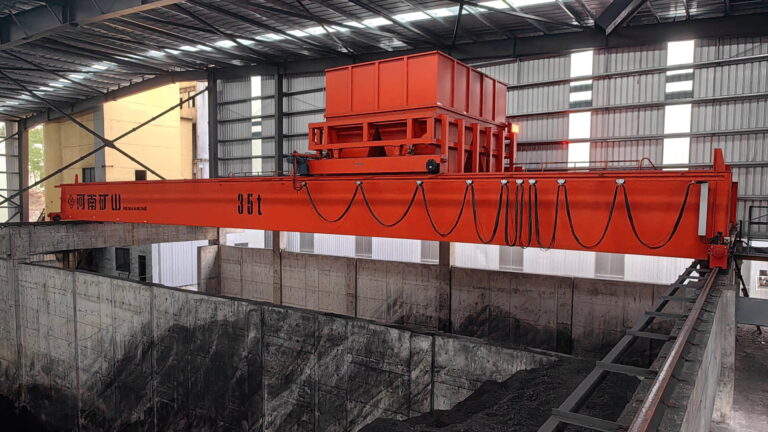
High-Capacity Steel Mill Crane Project
A process-critical ladle crane engineered with integral bridge and trolley machining, digital speed control, precision positioning, fault diagnosis and redundant protection.

360t heavy-duty casting crane installed for high-capacity molten-steel ladle handling.
| CustomerLuzhou Xinyang Vanadium-Titanium Steel | Rated Capacity360t heavy-duty casting crane | Plant Scale2-million-tonne steel production capacity | ApplicationHeavy ladles and molten-metal loads |
Project Background
Henan Mine Crane supplied a 360t heavy-duty casting crane for Luzhou Xinyang Vanadium-Titanium Steel. The crane supports the molten-metal handling requirements of a steel production system with an annual capacity of 2 million tonnes.
The project required more than high lifting capacity. A 360t ladle crane must control a very large suspended load through the complete steelmaking route, position it accurately at process stations and remain available for production-critical service. Bridge stiffness, trolley alignment, hoisting redundancy, braking, digital control, monitoring and heat protection therefore had to be engineered as one system.
The bridge and trolley frames were integrally machined using large processing equipment to improve assembly precision and operating performance. Digital speed regulation, position control, fault diagnosis and redundant protection were incorporated around the demands of heavy ladle handling.
Procurement priority: A 360t casting crane should be evaluated as a complete process machine. Rated capacity, load spectrum, ladle route, duty class, redundant mechanisms, control accuracy, thermal exposure and runway reactions must be reviewed together.
The High-Capacity Ladle Handling Challenge
A full steelmaking ladle combines the weight of the vessel, refractory lining, molten metal, hook blocks and lifting attachment. The crane must carry this total through repeated production cycles without excessive deflection, misalignment or sudden movement. Dynamic effects during acceleration and braking are significant at this capacity and must be considered in the structure and mechanisms.
Operators also need two different motion characteristics. The crane should travel efficiently through clear parts of the route, then approach furnaces, refining stations or casting positions at a stable creep speed. Accurate control is essential because small movements at the trolley or bridge translate into substantial movement at the suspended ladle.
The crane is part of the plant’s production chain, so reliability and maintainability directly affect output. Faults must be detected early, safety functions must respond predictably, and service teams need access to brakes, drives, drums, electrical equipment and monitoring devices.
360t Casting Crane Engineering Solution
Henan Mine Crane configured the 360t crane around the plant’s heavy ladle route and steelmaking duty. The bridge, trolley, hoisting mechanisms, travel systems, electrical controls, below-the-hook equipment and safety functions were developed as a coordinated design.
The heavy-duty bridge provides the stiffness and wheel-load distribution required by the large trolley and suspended load. The main hoist handles the full ladle, while the auxiliary lifting function supports process or maintenance tasks defined in the approved operating plan. Variable-speed drives manage lifting, trolley travel and bridge travel.
Buyers planning a comparable project can review Henan Mine Crane’s metallurgical overhead crane range and the 200t four-girder casting crane solution when comparing capacities, trolley arrangements and plant duty.
|
Heavy-duty bridge, trolley and hook arrangement serving the molten-metal production route. |
Casting crane operation inside the high-temperature steelmaking environment. |


Integral Machining for Bridge and Trolley Precision
At 360t capacity, dimensional consistency has a direct effect on wheel contact, trolley travel, shaft alignment and mechanism life. The project used large processing equipment to machine the bridge and trolley frames integrally, improving the relationship between critical mounting surfaces and operating reference points.
Integral machining supports accurate assembly of wheel groups, gearboxes, drums, bearings and drive components. Better alignment helps reduce abnormal wheel loading, skewing, vibration and uneven wear. It also gives commissioning teams a more consistent mechanical base for drive setup and motion adjustment.
For buyers, manufacturing capability should be part of technical evaluation. A high-capacity crane proposal should explain how main structures are fabricated, stress-relieved where required, machined, inspected and trial-assembled before delivery.
Digital Speed Control and Precise Positioning
Digital drive control gives the crane a controlled speed range for heavy-load transfer. The main hoist, trolley and bridge can accelerate smoothly, move at production speed and decelerate before entering a sensitive process area. Creep-speed operation supports final ladle positioning.
Position feedback and motion limits help the operator approach designated stations consistently. The final accuracy depends on the crane layout, load behavior, travel distance, drive system and process interface. When required, defined positions and interlocks can be exchanged with the plant control system.
Smooth control also reduces mechanical shock to the bridge, trolley, ropes, hooks, brakes and runway. This is especially valuable for a heavy crane operating through frequent steelmaking cycles.
|
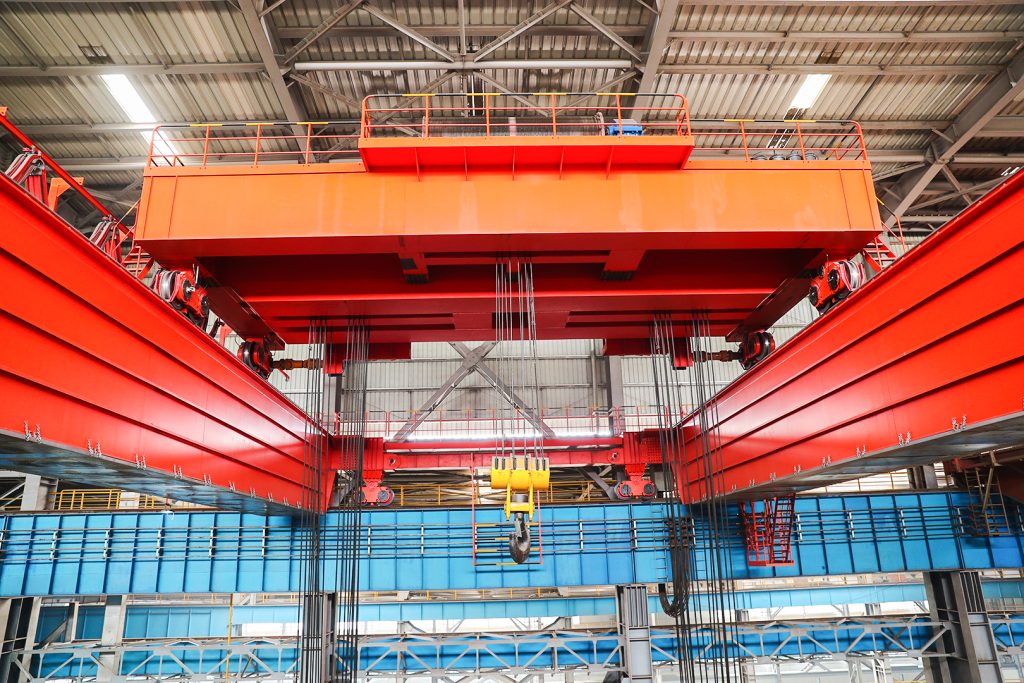
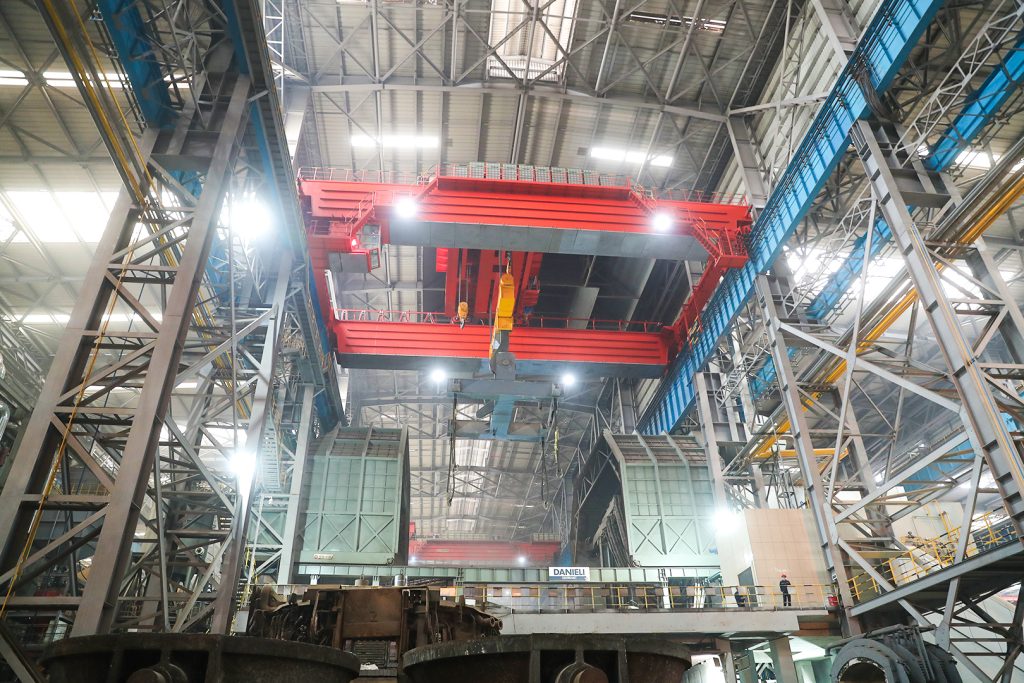
Large-capacity casting crane structure engineered for heavy ladle service. |
Main lifting and hook system for controlled molten-metal load handling. |
Redundant Protection for Process-Critical Lifting
A casting crane operates above molten metal, so the required redundancy is established from the governing crane standard and the plant risk assessment. The hoisting system, brakes, ropes, drums, drive architecture and electrical controls are reviewed for safe behavior under normal and fault conditions.
Braking arrangements are selected around the hoist torque, load path and emergency requirements. Overload protection prevents lifting beyond the approved configuration, while upper and lower limits control the hook path. Bridge and trolley limits, anti-collision functions and restricted travel zones are configured from the final workshop layout.
Redundancy should be stated clearly in the quotation. Buyers should compare the number and type of brakes, hoisting arrangement, fault response, emergency lowering strategy and permitted operating modes rather than relying on a general statement that the crane is “heavy duty.”
Fault Diagnosis and Safety Monitoring
The control system monitors project-defined operating conditions and displays faults to the operator and maintenance team. Typical monitored points include load status, hoist limits, motor and drive condition, brake response, mechanism position and communication health.
Diagnostic information helps maintenance personnel identify whether a shutdown originates in the drive, brake, sensor, limit circuit or power system. Alarm history and operating data can support preventive maintenance and reduce the time required to locate intermittent faults.
Safety monitoring is combined with physical inspection and planned maintenance. The crane operator and service team still verify hooks, ropes, brakes, wheels, lubrication, electrical enclosures and structural condition according to the approved maintenance program.
Heat and Steel-Plant Environmental Protection
The crane operates around radiant heat, dust and fumes generated by steelmaking. Heat shields, component locations, cable selection, electrical enclosure protection and ventilation are matched to the actual exposure along the ladle route.
The buyer should provide maximum ambient temperature, molten-metal temperature, distance between the ladle and crane, duration of heat exposure and any corrosive atmosphere. These conditions affect motors, brakes, sensors, cables, insulation, control panels and the operator station.
Maintenance platforms, inspection access and service clearances are reviewed during engineering. A well-designed access arrangement supports routine inspection without introducing unnecessary delays to the production schedule.
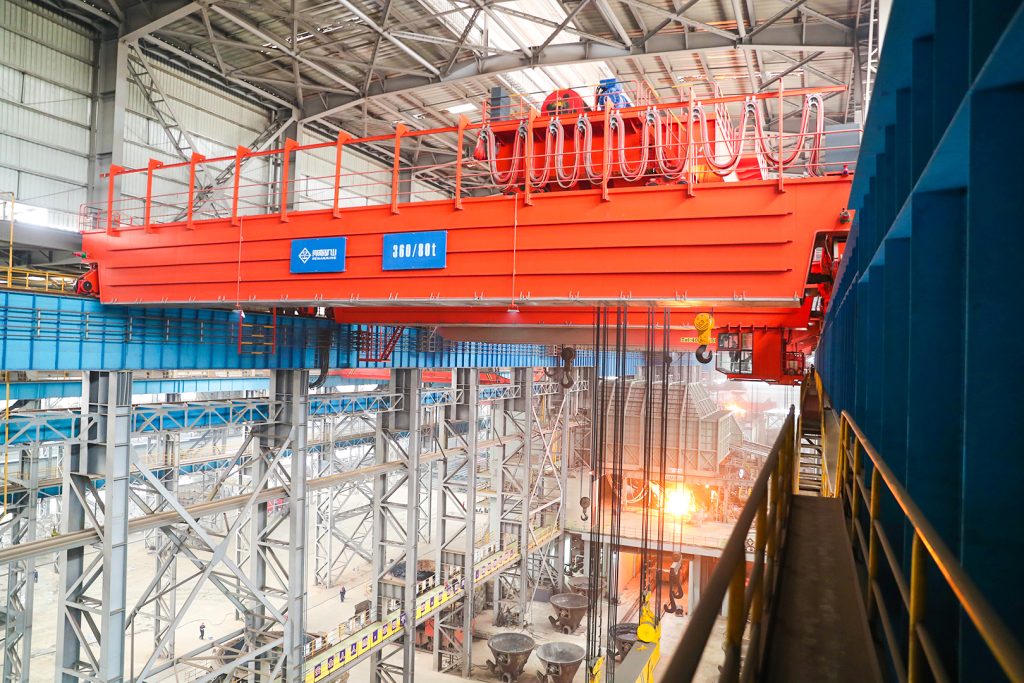
360t casting crane installed above the molten-metal handling route at Xinyang Vanadium-Titanium Steel.
Key Project Configuration
| Project Item | Configuration and Buyer Value |
|---|---|
| Crane Type | 360t heavy-duty casting and ladle overhead crane for molten-metal service. |
| Production Context | Supplied for a vanadium-titanium steel facility with 2-million-tonne production capacity. |
| Precision Manufacturing | Integral machining of bridge and trolley frames improves assembly alignment and operating performance. |
| Motion Control | Digital speed regulation supports efficient transfer and controlled final positioning. |
| Diagnostics | Fault diagnosis and safety monitoring provide operating status and maintenance information. |
| Protection | Redundant mechanisms and project-defined safety functions support process-critical ladle handling. |
Project Result
The 360t casting crane provides Xinyang Vanadium-Titanium Steel with a high-capacity handling system for heavy ladles and molten-metal loads. Integral machining supports mechanical alignment, while digital drives provide the controlled movement needed around process stations.
Fault diagnosis, monitoring and redundant protection support reliable operation in a production-critical steelmaking route. The project combines manufacturing capability, control performance and metallurgical safety in one heavy-duty crane platform.
For buyers comparing very large casting cranes, the 450t four-girder casting crane project provides another reference for high-capacity molten-metal handling.
Information Required for a 360t Casting Crane Quotation
Provide the following information so the crane structure, mechanisms, safety system and commercial scope can be engineered around your steelmaking route:
| Load Data Full ladle weight, molten-metal weight, vessel dimensions, attachments and auxiliary loads |
Workshop Layout Span, runway length, lifting height, headroom, hook approaches and process stations |
Duty Cycle Lifts per hour, daily operating time, load spectrum, travel route and required speeds |
| Environment Ambient and ladle temperatures, heat exposure, dust, fumes and electrical conditions |
Safety Standard Applicable crane code, required redundancy, monitoring, positioning and fault response |
Project Scope Testing, transport, installation, commissioning, training, spare parts and service |
Use the crane duty class guide to prepare the operating load spectrum and the overhead crane preventive maintenance checklist to define service and inspection expectations.
Frequently Asked Questions
What must be included in the 360t rated load?
The approved load calculation must include the ladle, molten metal, hook block, lifting beam and every attachment carried by the main hoist. The quotation should identify all permitted load combinations.
Is a 360t casting crane always a four-girder crane?
Not automatically. Capacity, span, trolley layout, lifting height, duty class, redundancy and the selected design standard determine the structural arrangement. The workshop drawing and process route must be reviewed before configuration.
Why is integral machining important for a large casting crane?
It improves the dimensional relationship between wheel, bearing, gearbox, drum and drive mounting surfaces. Better alignment supports smoother travel, balanced loading and longer component life.
Can the crane provide low-speed ladle positioning?
Yes. Digital variable-speed drives provide controlled acceleration, production travel and creep-speed positioning. Feedback and interlocks can be configured for the required process positions.
What fault diagnosis can be included?
The system can report drive, brake, sensor, limit, load and communication conditions. Alarm history and operating data can also be provided to support maintenance planning and troubleshooting.
Request a 360t Casting Crane Quotation
Send your full-ladle data, steelmaking route, workshop drawing, duty cycle and required safety standard. Henan Mine Crane will prepare a project-specific heavy-duty casting crane configuration, technical proposal and commercial quotation.