








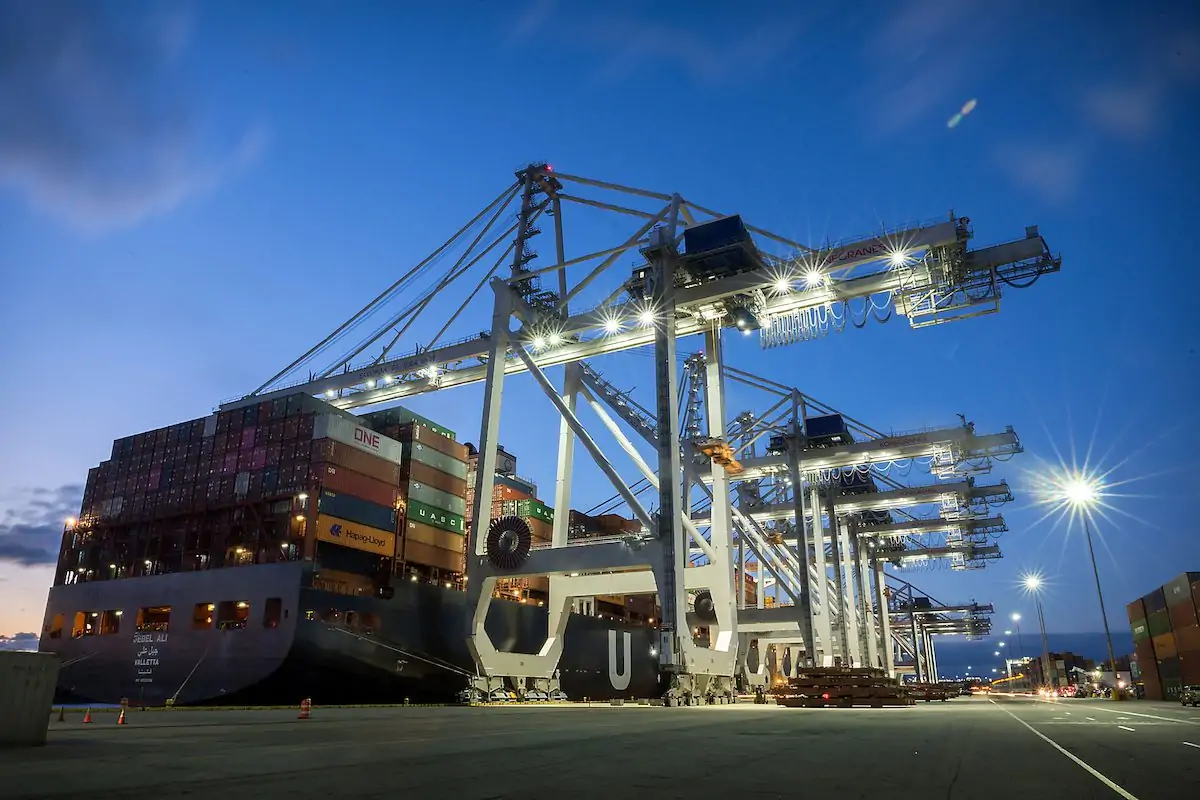
Where it is used
Container berths
Load and discharge containers between vessel and quay.
Terminal expansion
Match outreach and lift height to the design vessels.
Automated terminals
Connect the crane to the selected landside vehicles and control system.
Product features
Vessel-matched outreach
Boom and trolley geometry reach the required container rows.
Defined lift envelope
Above-rail and below-rail working heights follow vessel and water-level conditions.
Terminal integration
Spreader modes and vehicle interfaces follow the required handling process.
Technical specifications
| Catalogue selection | KSCRANE 65 t STS configuration |
|---|---|
| Rated load under spreader | 65 t |
| Rated load under hook | 75 t |
| Lift above rail | 42 m |
| Lowering below rail | 20 m |
| Total vertical lifting range | 62 m |
| Front outreach | 65 m |
| Rear outreach | 25 m |
| Rail gauge | 30.48 m |
| Total trolley travel distance | 120.48 m |
| Inside clearance between legs | At least 18.5 m |
| Clear height below middle cross beam | At least 13 m |
| Distance between gantry bumpers | 27 m maximum |
| Full-load hoisting speed | 90 m/min |
| No-load hoisting speed | 180 m/min |
| Trolley travel speed | 240 m/min |
| Gantry travel speed | 45 m/min |
| Boom hoisting time, one way | 5 min |
Published KSCRANE 65 t catalogue selection. Every dimension and speed in this table belongs to the same 65 t column; 75 t is the separate under-hook rating. Final loads, reach and wheel reactions are confirmed against your vessel and quay drawings.
Price guide
Request a berth-specific proposal with design-vessel drawings, outreach, rail gauge, lift above and below rail, spreader modes and delivery destination.
What affects the price?
- Design vessel and lift envelope
- Single / twin-lift arrangement
- Target moves per hour
- Quay wheel-load limits and automation
- Shipping, erection and commissioning
Typical configurations
Container pickup
Container spreader
Confirm the container formats and ship-to-shore handling interface.
Quay travel
Rail-mounted movement along the berth
Coordinate rail positions and berth infrastructure with the crane layout.
Ship coverage
Waterside outreach, landside backreach and above/below-rail lift
Use vessel and berth dimensions to define the full container-transfer envelope.
Final capacity, dimensions and operating functions are agreed for your load and site.
Compare related models
Compare the lifting arrangement and site layout before choosing a model.
Configuration
Fixed-rail gantry crane for container stacking and transfer across defined yard blocks, truck lanes or railway interfaces.
Consider it when
High-density container stacking or intermodal transfer is required away from the ship interface.
Configuration
Rubber-tired mobile machine combining container lifting, loaded travel, stacking and repositioning.
Consider it when
Containers need flexible movement between yard, truck and rail-side positions without a continuous crane runway.
Configuration
Multipurpose slewing port crane that can be configured with hook, grab or other cargo-handling attachments.
Consider it when
A multipurpose berth handles bulk cargo, steel, machinery or mixed cargo rather than operating as a dedicated container berth.
Frequently asked questions
Why is rated capacity insufficient for STS selection?
A crane must also reach the vessel positions and provide the required vertical envelope. Quay reactions, spreader mode and cycle performance can control the design.
Can an existing quay accept a larger crane?
Only after checking the quay structure, rails, reactions and interfaces. More outreach or capacity can change demands on the berth and erection arrangements.