









Where it is used
Steel stocking
Align long products with storage positions without relying only on bridge and trolley travel.
Vehicle loading
Orient approved steel loads to match the loading direction.
Production transfer
Turn components between pickup and delivery positions within the verified load envelope.
Product features
Rotating lifting beam
The rotation arrangement helps align the load with the next handling position.
Rotation monitoring
Position sensing and rotation limits support the approved operating range.
Attachment choice
Magnets or clamps are selected for the product shape, material and temperature.
Technical specifications
Model: QLC
| Model | QLC |
|---|---|
| Lifting capacity | 5 – 50 t |
| Span | 10.5 – 31.5 m |
| Lifting height | 6 – 20 m |
| Working duty | A6 – A7 |
| Protection level | IP54 |
| Power supply | 220-690V, 50/60 Hz |
| Control method | Wireless Remote / Cabin Control |
Published selection ranges are configuration dependent. Rated load, span, height, speed and duty are confirmed together in the project drawing.
Price guide
Request a configuration-specific price for this crane. The quotation is based on the lifting task, site dimensions and the equipment scope below.
What affects the price?
- Rated load, lifting attachment and duty cycle
- Bridge span, lifting height and runway length
- Motion controls, electrical supply and destination requirements
- Freight, runway structure, installation and commissioning scope
Typical configurations
Lifting Attachment
Lower-rotating electromagnetic lifting beam
Match the pickup method to the material, load geometry and handling sequence.
Rotation Control
Photoelectric angle sensing with rotation-limit braking
Match transfer and final placement to the required operating sequence.
Anti-Sway
Mechanical bidirectional V-rope reeving + electrical anti-sway control
Match this arrangement to the load and the complete handling route.
Final capacity, dimensions and operating functions are agreed for your load and site.
Related project experience
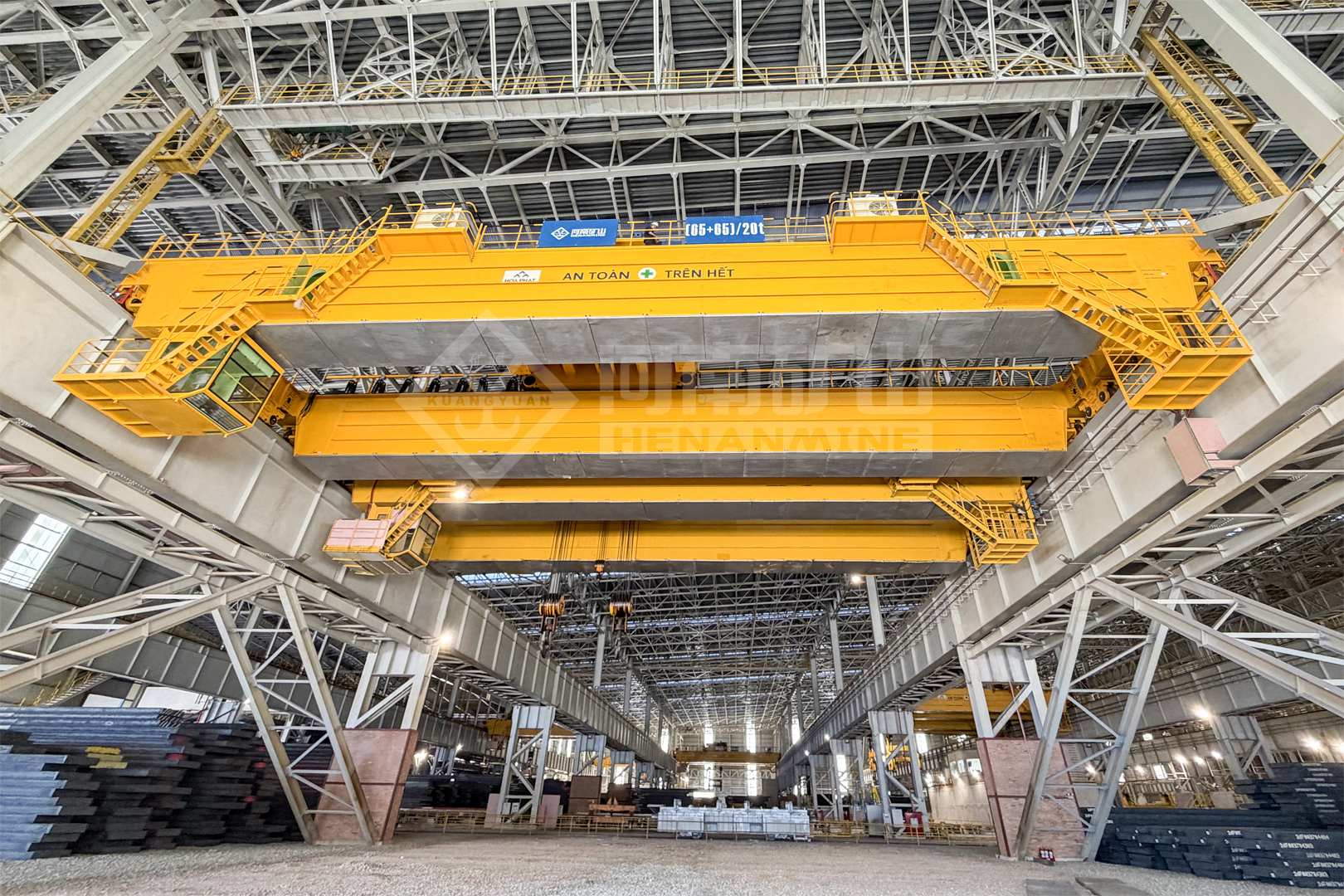
Related steel-handling crane package
Rotating steel handling and scrap-yard lifting
- More than 100 cranes supplied for a Southeast Asian steel plant.
- The package includes downward-rotating electromagnetic beam cranes.
- Double-girder double-trolley gantry cranes serve the port scrap yard.
The package uses different lifting attachments and crane structures for different process areas. Confirm the required rotation envelope, load interface and handling route before selecting your configuration.
View project detailsCompare related models
Compare the lifting arrangement and site layout before choosing a model.
Configuration
Uses a fixed electromagnetic lifting beam with multiple magnetic pickup points but does not require the QLC lower-rotating mechanism.
Consider it when
Long plates, ingots or sections require distributed magnetic pickup, but pickup and discharge orientation remain substantially the same.
Configuration
Uses a hook-mounted concentrated electromagnetic lifting device rather than a long multi-point rotating magnetic beam.
Consider it when
The magnetic load can be handled effectively by a concentrated electromagnetic attachment and a long lifting beam or rotation function is unnecessary.
Configuration
Changes lifting attachments to perform hook, grab and electromagnetic handling instead of being dedicated to a rotating electromagnetic beam process.
Consider it when
One crane must handle conventional suspended loads, loose bulk material and magnetic steel rather than optimize the complete crane around rotating long-steel handling.
Information for your quotation
Send steel dimensions, batch weights, maximum temperature and pickup-surface drawings or photos. Include the beam, magnets and suspended accessories in the load definition.
Provide span, stack heights, pickup and placement directions, nearby obstacles and cycles per hour. Define backup holding, alarms, operator controls and magnetic-system acceptance requirements.
Frequently asked questions
How does QLC differ from a fixed beam?
QLC adds horizontal rotation below the trolley. A fixed beam suits transfer where pickup and placement orientations remain unchanged.
Can one magnet layout handle every size?
The usable range depends on product dimensions, contact area and material condition. Confirm both the smallest and largest products.
Is emergency holding time fixed?
Backup holding duration must be agreed for the selected magnetic system, actual load and site emergency procedure.
Product views and components

