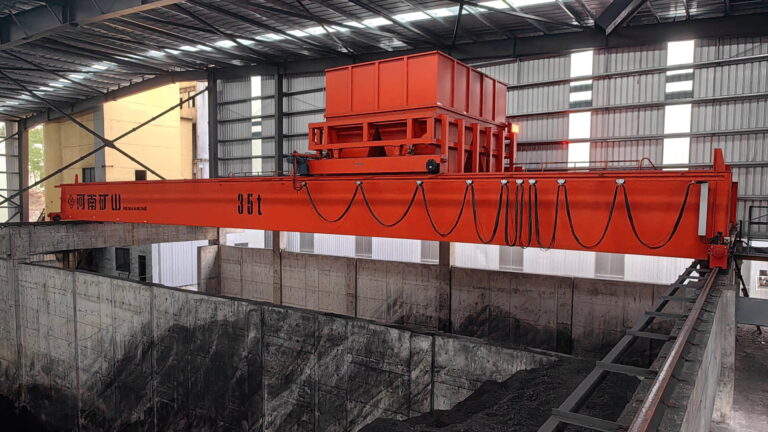
Wind Turbine Manufacturing Crane Project
A coordinated double-girder overhead crane fleet with full VFD control, large-span precision travel and modular installation for wind turbine mainframe production and assembly.
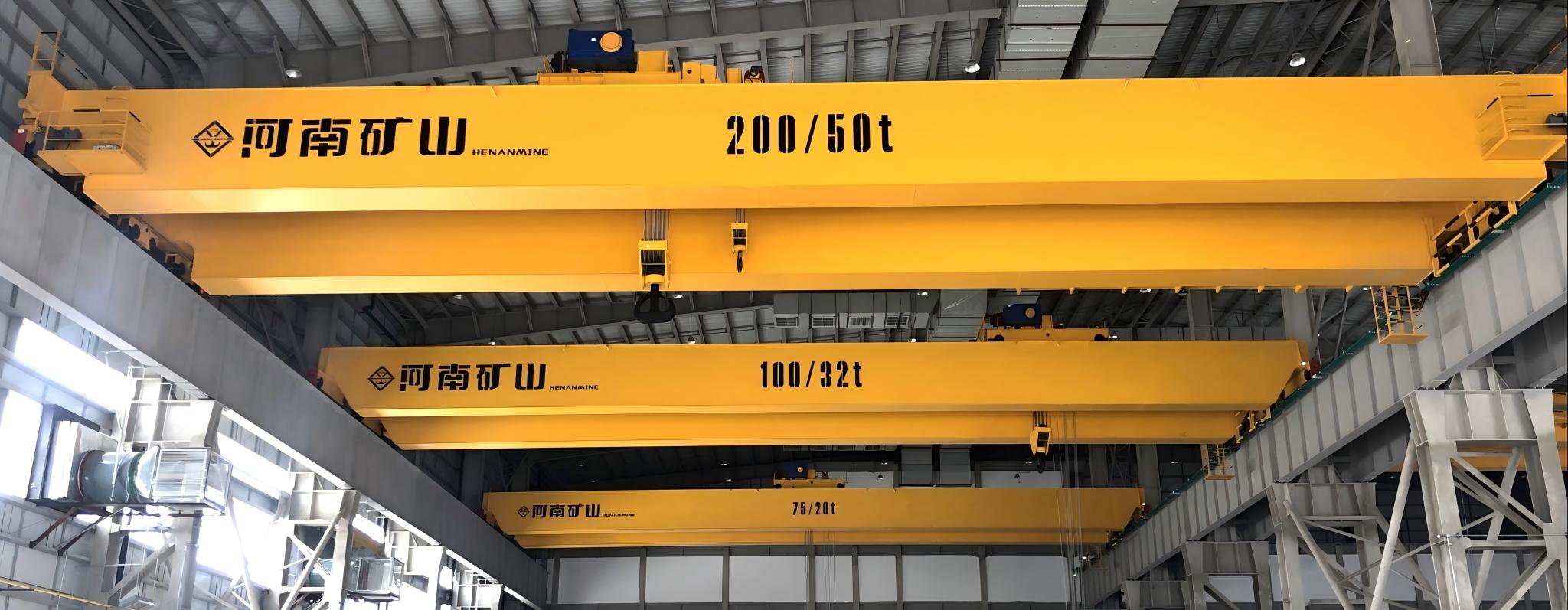
Three application-specific crane capacities serving heavy assembly, component handling and production support within one wind turbine manufacturing workshop.
| ApplicationWind turbine mainframe production and assembly | Installed Capacities200/50t, 100/32t and 75/20t | Motion ControlFull variable-frequency control | InstallationModular design and quick electrical connections |
Project Background
A wind turbine manufacturing base required a group of overhead cranes for mainframe production, nacelle assembly, component transfer, tooling changes and maintenance. Lifting loads varied significantly by workstation, from very heavy main structures to medium-capacity assemblies and production-support tasks.
Henan Mine Crane supplied a batch of large-span, high-precision and low-energy double-girder overhead cranes for the production line. The installed fleet includes 200/50t, 100/32t and 75/20t crane configurations, allowing each work area to use capacity and hook arrangements matched to its lifting process.
The cranes use full variable-frequency control, modular construction and quick aviation-plug wiring. A one-time lifting installation concept without onsite welding reduced field assembly work and helped the crane schedule follow the new factory construction program.
Planning a wind turbine crane fleet? Send a crane schedule for every bay, including component weights, lifting points, span, lift, runway length, hook arrangement, production cycle, speeds, positioning tolerance, power supply and installation sequence.
Manufacturing Line Lifting Challenges
Wind turbine factories handle mainframes, nacelle housings, generators, gearboxes, hubs, shafts, fixtures and assembly tooling. Each workstation has a different maximum load, lifting-point geometry, travel route and positioning requirement.
Specifying one high-capacity crane for every bay increases equipment, runway and building costs. Specifying unrelated cranes independently can create inconsistent controls, spare parts, maintenance procedures and operator interfaces across the plant.
Large spans require stable bridge structures and accurate travel. High-value components need smooth acceleration, controlled low speed and predictable stopping so they can approach fixtures without shock or unnecessary sway.
The plant construction schedule also limits onsite work. Crane installation must coordinate with roof completion, runway readiness, mobile-crane access, electrical supply and production-equipment delivery.
Capacity Matching Across the Crane Fleet
The project fleet uses several main and auxiliary hook capacities. The 200/50t crane serves the heaviest wind turbine mainframe and assembly lifts. The 100/32t crane supports medium-heavy component handling, while the 75/20t crane covers lower-capacity assembly, tooling and maintenance work.
Main and auxiliary hooks give each crane additional flexibility. The main hook is selected for the heaviest approved lifts; the auxiliary hook can handle smaller components or support orientation and rigging tasks when permitted by the lifting plan.
For a new plant, capacity includes component weight, lifting-beam and rigging weight, dynamic allowance and future turbine models. Buyers can review double-girder overhead crane configurations and industrial manufacturing crane applications before finalizing the fleet schedule.
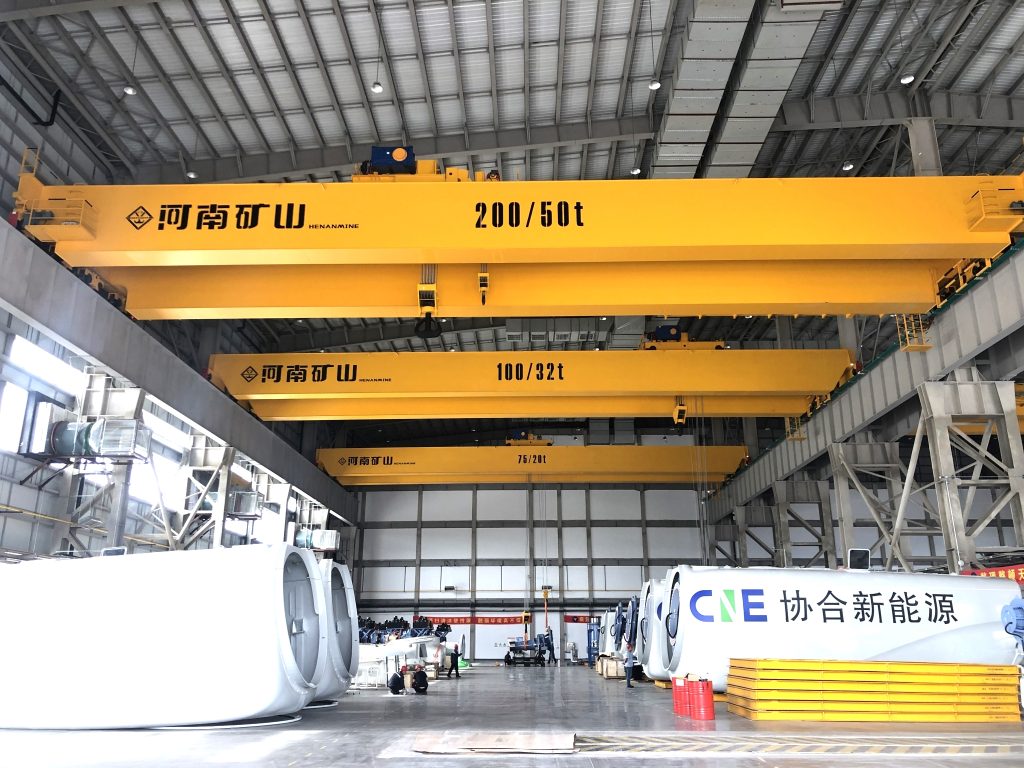
200/50t crane positioned above large wind turbine structures and production components. |
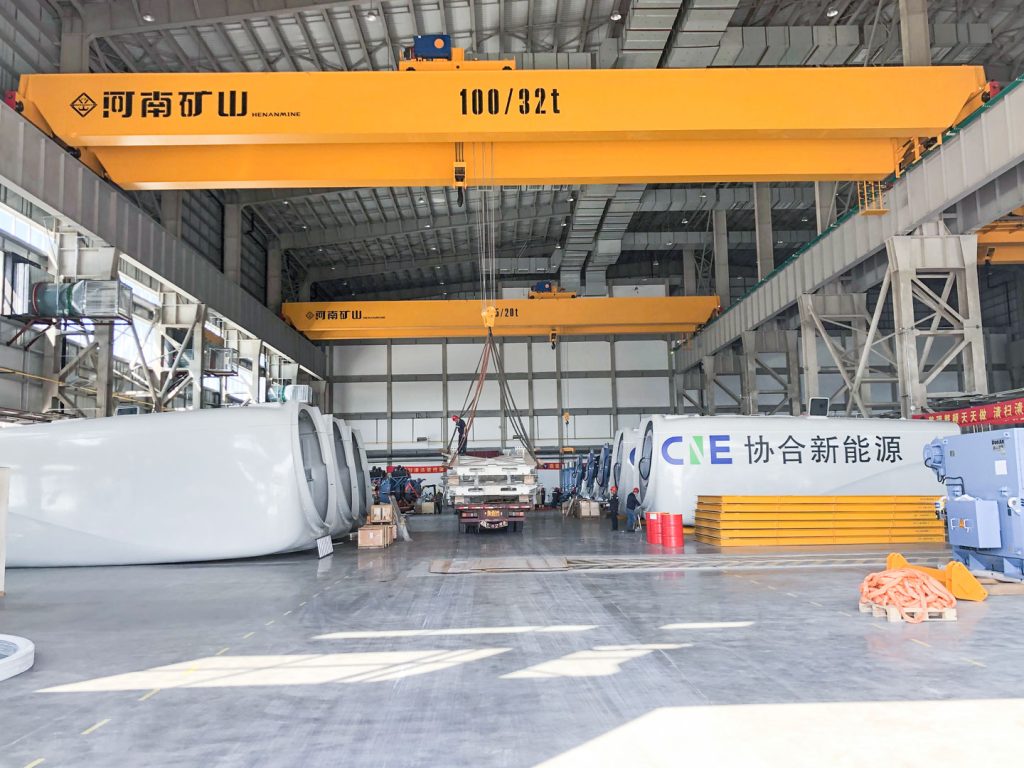
100/32t crane serving medium-heavy component transfer and assembly operations. |
Full Variable-Frequency Control
Full VFD control provides smooth acceleration and deceleration for hoisting, trolley travel and bridge travel. Controlled motion reduces dynamic loading on the crane and runway and helps protect large wind turbine components during repeated production handling.
Faster travel can be used between workstations, while low-speed movement supports final approach to an assembly fixture or transport stand. Speed ranges, acceleration times and minimum controllable speed are selected from load geometry, travel distance and production tolerance.
Variable-frequency operation also avoids unnecessary high-speed running during lighter or short-distance tasks. Across a multi-crane plant, this supports lower energy consumption and a more consistent operator experience.
Large-Span Precision Travel
Wind turbine production bays require wide clear working areas for large components, transport vehicles and assembly stations. The bridge structure is engineered for the required span, capacity, hook arrangement and duty while controlling deflection and wheel-load distribution.
Travel systems are configured for straight and stable movement along the runway. Wheel arrangement, drive synchronization, rail tolerances and end-carriage geometry are checked together to reduce skewing and maintain predictable hook travel.
The buyer should provide the building grid, runway elevation, rail data, column spacing and structural load limits. Crane and workshop engineering can then be coordinated before bridge fabrication begins.
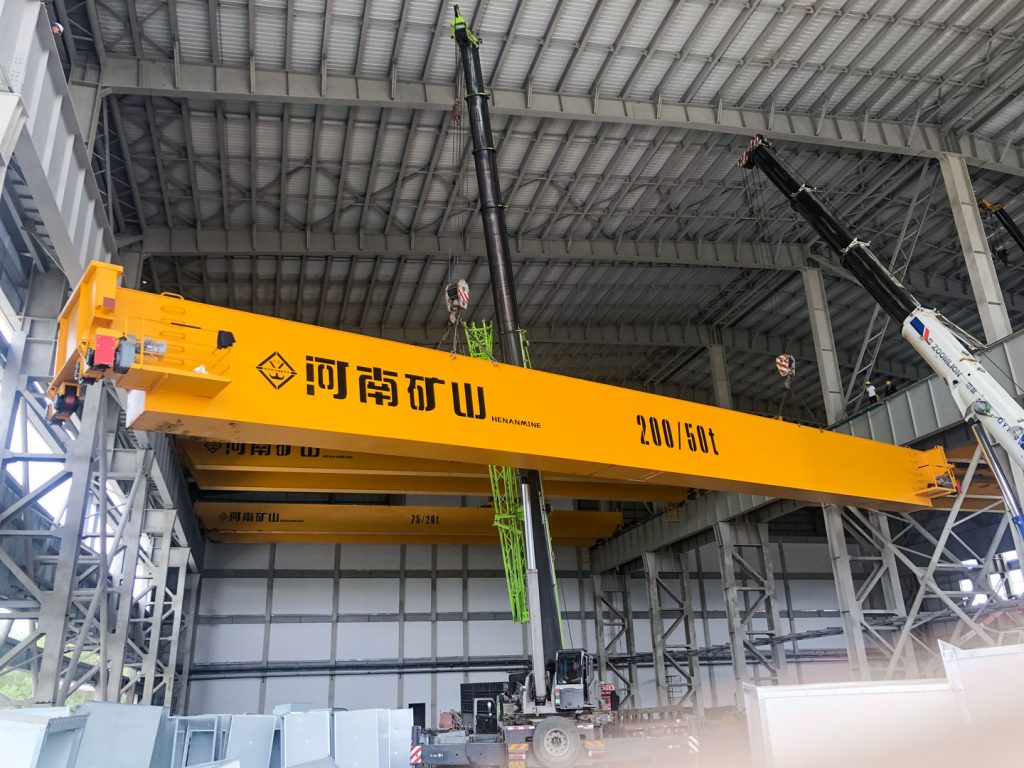
The modular 200/50t crane bridge is lifted into position as one coordinated installation unit.
Modular Installation with Quick Connections
The project cranes use modular construction to simplify manufacturing, transport and site assembly interfaces. Major bridge, trolley, electrical and access components are prepared as coordinated modules before shipment.
Quick aviation-plug connections reduce field electrical termination work and help prevent wiring inconsistencies. Each interface is identified for efficient installation, inspection and future component replacement.
The one-time lifting installation concept allows the prepared bridge assembly to be hoisted onto the runway without onsite welding during the crane installation process. This shortens field work, reduces hot-work coordination and helps the installation follow the production-building schedule.
Fleet Standardization and Maintenance
Although capacities differ, the project applies a common design and control philosophy across the crane fleet. Standardized drives, control interfaces, safety logic and maintenance concepts reduce training and spare-parts complexity.
Maintenance teams can use consistent inspection procedures while still following capacity-specific checks for ropes, hooks, brakes, gearboxes and structures. Common components can be stocked across several cranes where duty and technical requirements allow.
Modular assemblies also simplify replacement planning. Access routes, lifting points and isolation locations are considered in the layout so maintenance can be completed without unnecessary disruption to adjacent production bays.
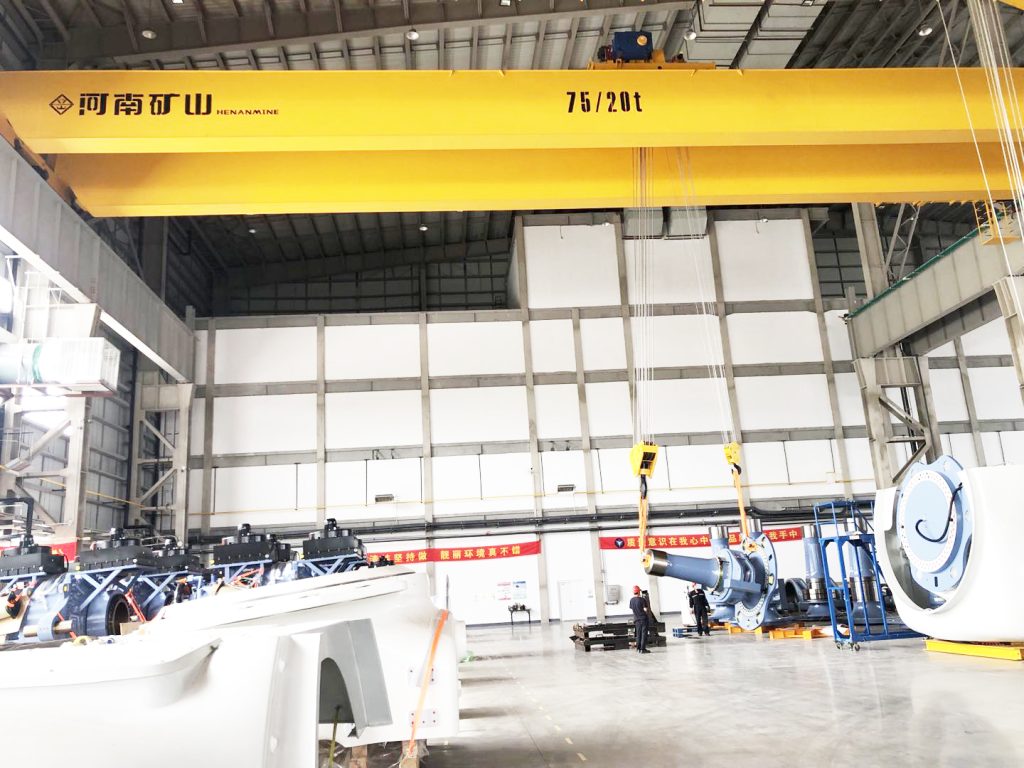
The 75/20t crane supports component handling, tooling and lower-capacity assembly work within the fleet.
Workshop and Production Layout Coordination
Each crane is coordinated with workstation positions, component stands, transport lanes, runway length and future expansion areas. Hook approach and lifting height are checked against the largest component, lifting beam, rigging and production equipment.
Maximum wheel loads, horizontal forces and runway tolerances are supplied to the building designer. The electrical supply, conductor system, maintenance zones, access platforms and end clearances are also included in the general arrangement review.
A fleet layout can divide operating zones or allow selected overlapping coverage according to the production process. Crane-to-crane collision prevention and travel limits can be configured where multiple units share or approach the same bay.
Safety, Testing and Commissioning
The crane package includes overload protection, hoisting limits, travel limits, brakes, buffers, emergency stopping and operating interlocks. Safety functions are matched to the approved main and auxiliary hook modes.
Factory inspection verifies structural fabrication, mechanisms, electrical panels, VFD functions, protection devices and project documentation. Installation checks confirm runway compatibility, bolted connections, quick electrical interfaces and equipment alignment.
Site commissioning covers no-load operation, speed ranges, smooth acceleration, low-speed positioning, limits, brakes and rated load tests. Operator and maintenance training uses standardized procedures across the fleet while identifying the specific duties of each crane.
Key Project Configuration
| Project Element | Installed Project Configuration |
|---|---|
| Application | Wind turbine mainframe production, component assembly, tooling and maintenance. |
| Crane Type | Large-span double-girder overhead crane fleet. |
| Installed Capacities | 200/50t, 100/32t and 75/20t main/auxiliary hook configurations. |
| Control | Full variable-frequency control for hoisting and travel. |
| Design | Large-span, lightweight and modular crane series. |
| Electrical Interface | Quick aviation-plug wiring for reduced field connection work. |
| Installation | One-time lifting installation concept without onsite welding during crane installation. |
| Fleet Strategy | Standardized controls and maintenance concepts with workstation-specific capacities. |
Project Result
The crane fleet gives the wind turbine factory application-specific lifting capacity across heavy mainframe assembly, medium component transfer, tooling and maintenance work. This avoids oversizing every workstation while keeping a coordinated plant-wide design.
Full VFD control provides smooth production movement and precise low-speed positioning. Large-span bridge engineering supports the wide manufacturing bays, while modular construction and quick electrical connections reduce installation work.
Standardized controls, components and maintenance practices simplify training and lifecycle service across the different crane capacities. The project provides a practical reference for wind turbine manufacturers planning a new production base or factory expansion.
Explore more new energy manufacturing crane solutions or compare additional industrial overhead crane options for a multi-bay production facility.
Information Required for a Wind Turbine Crane Fleet Quote
Send the following information so Henan Mine Crane can prepare a project-specific technical proposal and commercial quotation:
| Crane Schedule Crane quantity by bay, maximum and typical loads, component dimensions, lifting points, rigging weight, hook arrangement and future products |
Workshop Layout Span, runway length, lifting height, runway elevation, headroom, hook approaches, production stations, transport lanes and maintenance zones |
Production Duty Annual cycles, average load, shift pattern, travel distances, speeds, positioning tolerance, lifting sequence and availability target |
| Controls VFD requirements, operating stations, remote control, collision protection, load display, monitoring and factory-system interfaces |
Installation Plan Runway readiness, roof completion, mobile-crane access, lifting opening, electrical interface, delivery sequence and required completion date |
Commercial Scope Standards, inspection, packaging, transport, installation, commissioning, training, spare parts, warranty and lifecycle service |
Frequently Asked Questions
What crane capacities are used in a wind turbine manufacturing plant?
Capacity varies by workstation. This project uses 200/50t, 100/32t and 75/20t cranes, while a new fleet should be sized from the actual components, rigging and production duties in each bay.
Why use full VFD control for wind turbine cranes?
VFD control provides smooth acceleration, controlled deceleration and low-speed positioning while reducing unnecessary high-speed operation during frequent production handling.
Why specify main and auxiliary hooks?
A high-capacity main hook handles the heaviest components, while the auxiliary hook supports smaller loads, tooling, rigging and selected orientation tasks more efficiently.
Can the cranes be installed with less field work?
Yes. Modular design, aviation-plug electrical connections and a one-time lifting concept can reduce onsite assembly, wiring and welding work when the building and lifting access are prepared.
Can different crane capacities use standardized controls?
Yes. The fleet can share control philosophy, operator interfaces, safety logic and selected components while retaining capacity-specific structures and mechanisms.
What information is needed before pricing?
Provide a bay-by-bay crane schedule, component and rigging data, workshop drawings, capacity, span, lift, hook arrangement, duty, speeds, controls, standards, installation sequence and service scope.
Request a Wind Turbine Manufacturing Crane Quote
Send your component schedule, workshop layout, capacity by bay, hook arrangements, production duty, VFD control requirements and installation sequence. Henan Mine Crane will prepare a coordinated crane-fleet proposal and commercial quotation.