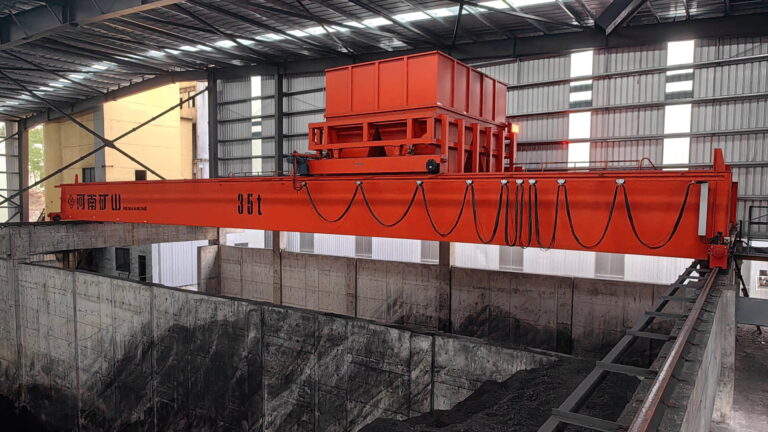
Smart Steel Plant Crane Project
Automated bulk-material handling with intelligent sensing, PLC control, precise positioning, anti-sway and remote dispatch in a hot, humid and low-visibility steel plant environment.
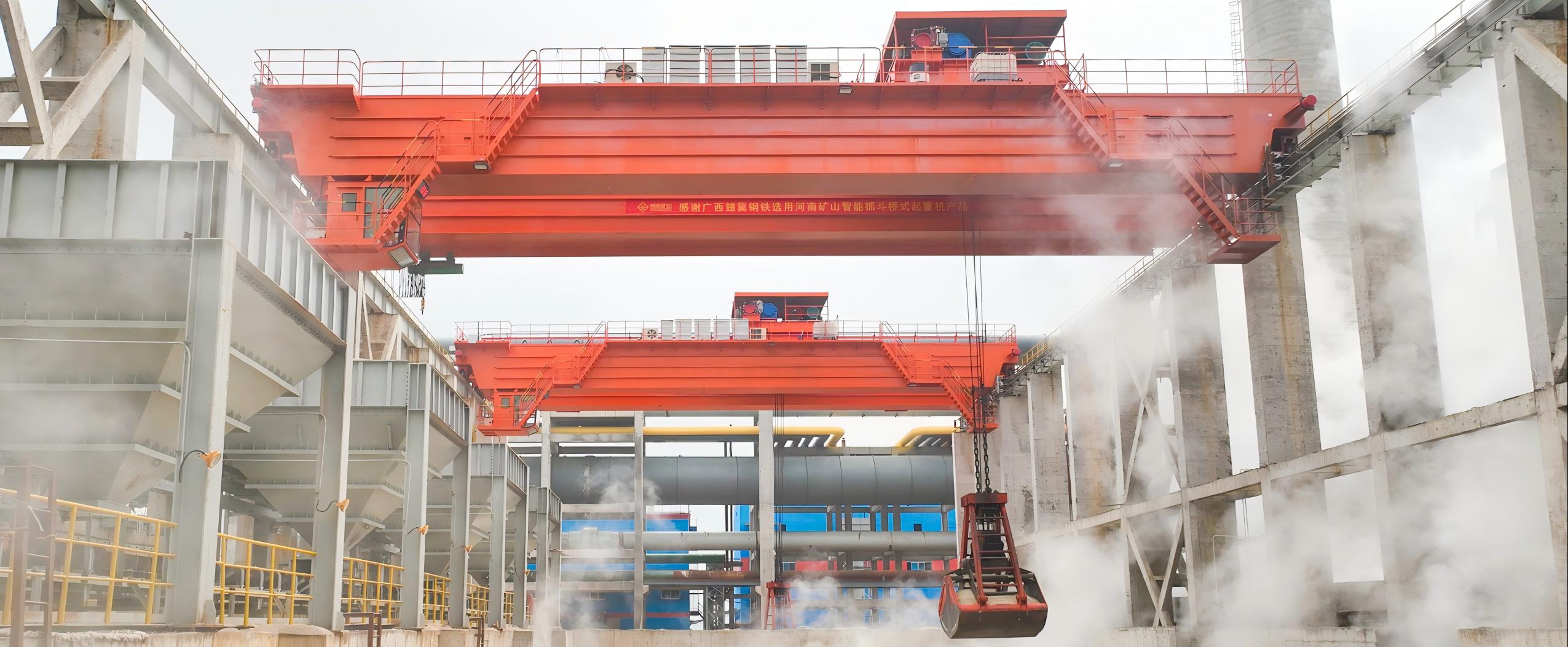
32t intelligent grab overhead crane system for automatic bulk-material pickup, transfer and discharge.
| CustomerGuangxi Chiji Steel | Project2060 m³ blast-furnace facility | Grab CranesFour 32t intelligent units | Total Crane Supply59 cranes of different types |
Automated Bulk Handling Around the Blast Furnace
Blast-furnace production depends on reliable movement of bulk raw materials and process materials. Grab cranes may need to collect material from defined storage or process positions, travel through a restricted production area and discharge into bins, hoppers or transfer points. Heat, humidity, steam and fog can reduce direct visibility while high cycle rates increase fatigue demand on the crane structure and mechanisms.
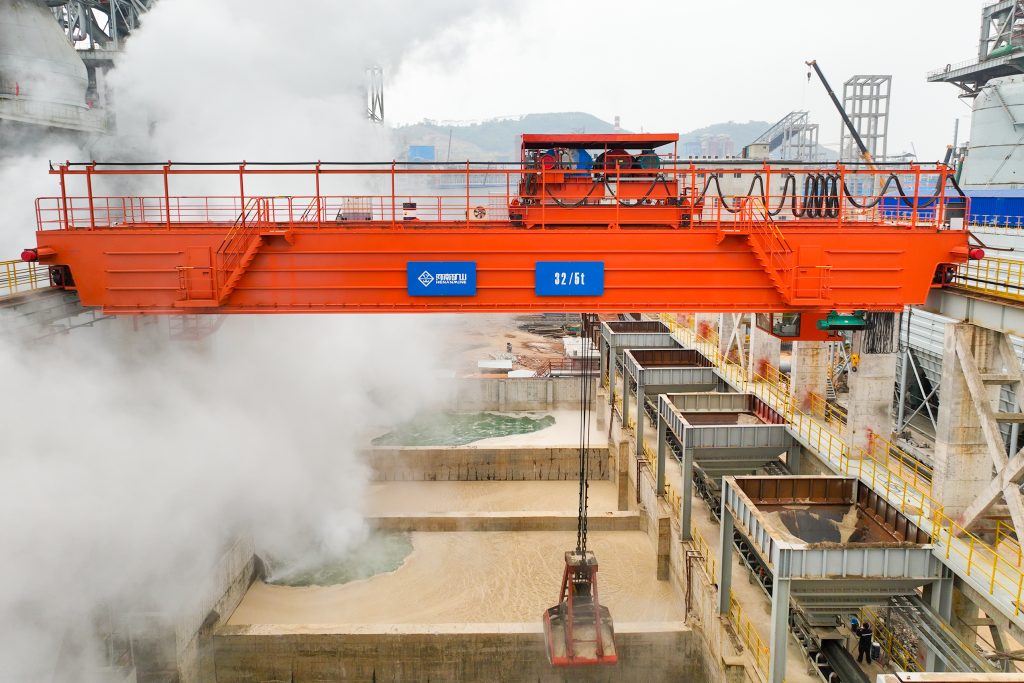
Henan Mine Crane supplied 59 cranes of different types to Guangxi Chiji Steel, including four 32t intelligent grab cranes for a 2060 m³ blast-furnace project. The grab cranes use PLC control, positioning and anti-sway systems. Intelligent sensing supports automatic grabbing, transfer and discharge in low-visibility conditions, while remote dispatch reduces the need for operators to remain in the process area.
For steel plants purchasing a similar system, the crane should be specified around material flow rather than rated capacity alone. The supplier needs the material type, bulk density, moisture, particle size, storage arrangement, pickup and discharge coordinates, required throughput, cycle frequency and environmental conditions before selecting the grab and crane mechanisms.
Buyer’s priority: Treat the grab, crane, sensors, material pile, receiving hopper and plant dispatch system as one automated handling process.
Selecting the Crane and Grab as One System
A 32t crane rating includes both the grab self-weight and the material carried inside it. The available payload therefore depends on grab weight, volume and the actual bulk density of the material. Using a large grab without checking density can overload the crane, while an undersized grab can reduce throughput and increase the number of cycles.
Grab type and closing force should match the material. Particle size, compaction, moisture and flow characteristics affect filling and discharge. The bucket geometry must also suit the storage pit, stockpile or bin opening so the automatic system can achieve repeatable pickup without contacting surrounding structures.
The crane supplier should calculate the expected material payload across the possible density range and define operating limits in the control system. Buyers can review the available grab overhead crane configurations before developing the project-specific automation scope.
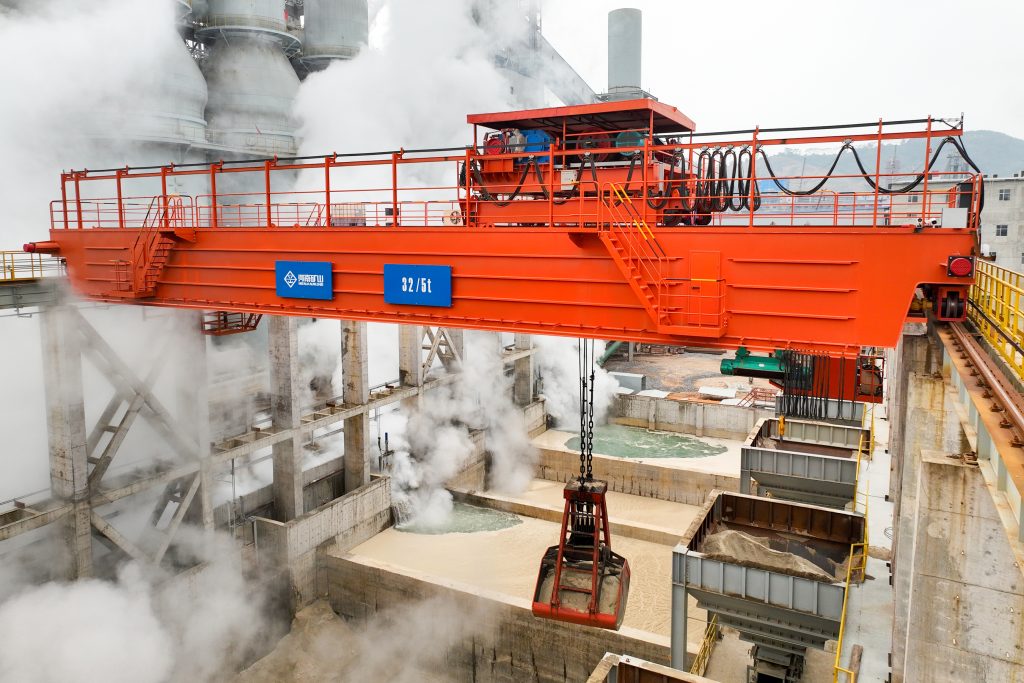
Project grab crane equipment configured for automatic bulk-material handling in the blast-furnace area.
Automatic Grabbing, Transfer and Discharge
An automatic cycle begins with a material-handling request from the dispatch or production system. The crane verifies route and equipment readiness, travels to the pickup zone, positions above the target, lowers the grab and completes the closing sequence. After confirming the handling state, it lifts, transfers the material and opens the grab at the programmed discharge point.
The cycle should account for changing pile height and shape. A fixed coordinate may not be sufficient after material has been removed from the area. Intelligent sensing can help the system identify the material surface and select a suitable pickup point. The exact sensor arrangement depends on fog, steam, dust, temperature and the required coverage.
Discharge logic must coordinate with the receiving hopper or process equipment. The system should confirm that the destination is ready and that the grab is within the permitted opening zone. Interlocks prevent discharge over an unavailable station or outside the target area.
Intelligent Sensing in Fog and Low Visibility
Steam and fog can block an operator’s direct view of the material pile, grab and receiving point. The project uses intelligent sensing to support automatic handling in these conditions. A practical sensor package should be selected using the real visibility range, moisture level, heat exposure and contamination expected in the blast-furnace area.
Sensing may be used to confirm crane position, material surface, grab height, pickup zone, hopper location and restricted areas. Sensors require protected mounting, suitable enclosures and access for cleaning or replacement. A device that works in a clean factory test must still remain usable after exposure to humidity, steam and dust.
The control system should evaluate sensor quality and stop or switch to an approved recovery mode when data is unreliable. Redundant or independent confirmation may be required for safety-critical positions according to the final risk assessment.
Positioning and Anti-Sway Control
Automatic grabbing and discharge depend on repeatable bridge, trolley and grab position. The project’s positioning system provides motion feedback, while anti-sway control limits load movement during transfer and approach. Stable arrival reduces the time required before the grab can be lowered or opened.
The required positioning tolerance should be defined at the grab rather than only at the bridge or trolley. Rope length, load swing, speed, acceleration and stopping distance influence the final result. Acceptance testing should use actual pickup and discharge positions under representative operating conditions.
Variable-frequency motion control can provide smooth acceleration, deceleration and low-speed positioning. Working speeds should balance throughput with stable material handling. The crane duty class must reflect the repeated grab cycle; the crane duty class guide helps buyers compare mechanism proposals.
|
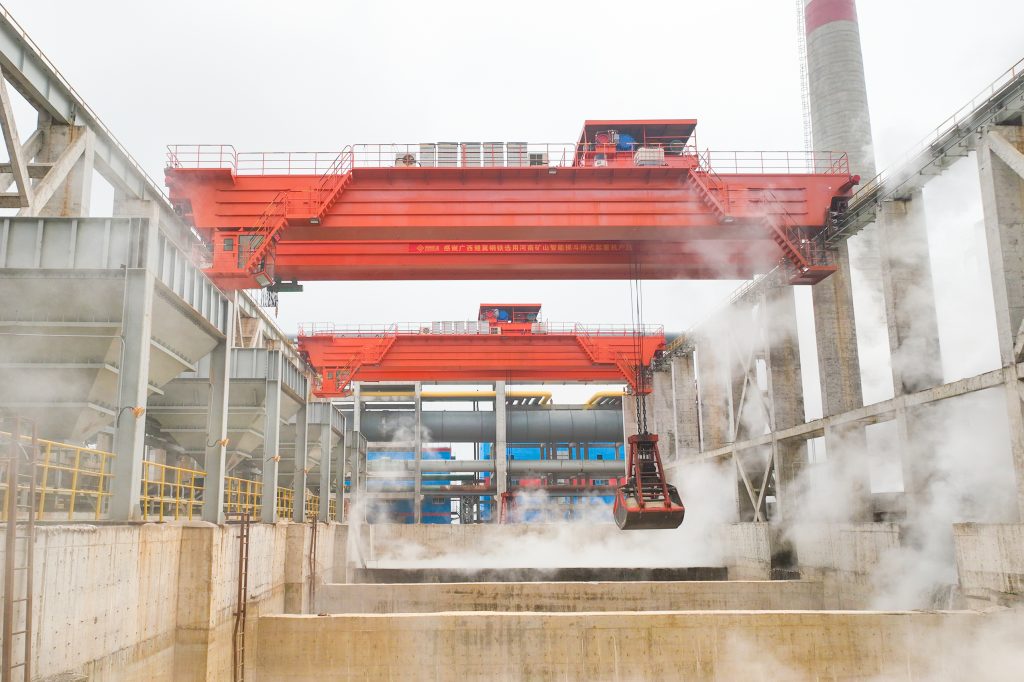
PLC-controlled grab crane equipment with positioning and anti-sway functions. |
Intelligent grab-crane system designed for remote operation in the steel plant. |
PLC Control and Remote Dispatch
PLC control coordinates bridge travel, trolley motion, hoisting and grab operation around the production sequence. Remote dispatch can assign handling tasks, manage priorities and monitor crane availability without requiring an operator to remain close to the hot and humid process area.
The interface with plant equipment should define ready, request, destination-available, cycle-complete and fault signals. Communication ownership and recovery behavior need to be agreed during design. Local crane safety functions should remain active if an upper-level dispatch or plant network is unavailable.
Automatic, remote-manual and maintenance modes allow production, troubleshooting and servicing under controlled conditions. User permissions and mode-change logic prevent automatic commands from conflicting with local maintenance work.
Heavy Wide-Box Structure for Fatigue Resistance
Grab cranes perform frequent lifting, opening, closing and travel cycles. Repeated dynamic loading creates greater fatigue demand than occasional maintenance lifting. The project uses a heavy wide-box structure designed for this demanding service.
Structural design should use the actual cycle frequency, load spectrum, crane class and dynamic effects. Girder stiffness, trolley loads, wheel loads, end-carriage forces and runway behavior need to be checked together. Fabrication quality, welding procedures, non-destructive examination and dimensional control support long-term performance.
Mechanisms must be matched to the same duty. Motors, brakes, gearboxes, drums, ropes, sheaves, wheels and grab components should be selected for the expected starts and operating hours. A double-girder overhead crane provides the structural platform, while the final design is adapted to grab service and automation.
Protection for Heat, Humidity, Steam and Dust
High temperature and humidity affect electrical enclosures, motors, brakes, cables, sensors and cameras. Condensation can reduce insulation performance and damage electronics, while dust can block cooling and contaminate moving components. The buyer should provide temperature, humidity, steam exposure, dust characteristics and cleaning requirements.
Protection may include appropriate enclosure ratings, anti-condensation heating, cooling or ventilation, protected cable routing, sensor shielding and corrosion-resistant finishes. Equipment should remain accessible for cleaning and inspection because the environment can quickly reduce sensor or camera performance.
Walkways, service platforms, lighting and component-removal space should be incorporated into the crane layout. The overhead crane preventive maintenance checklist can be adapted to include grab, sensing and automation equipment.
Safety Zones and Recovery Logic
Automatic grab operation needs defined travel, pickup and discharge zones. Access control, warning devices, emergency stops, load monitoring, travel limits, anti-collision measures and obstacle detection may be required according to the final plant risk assessment.
The system should stop or enter a safe state if it cannot confirm the material surface, grab position, route or destination. Recovery procedures should cover lost sensor data, incomplete grab closure, overloaded pickup, blocked hopper, communication loss and power interruption.
Remote operators need clear status, alarm and permitted-action information. Controlled manual recovery should allow authorized personnel to move the crane without bypassing essential protection.
Testing and Commissioning
Factory testing can verify PLC logic, drives, mode selection, alarms, simulated sensors, grab controls, dispatch interfaces and interlocks. Site commissioning then confirms actual coordinates, sensor performance, pile detection, grab filling, positioning, anti-sway and discharge accuracy in the production environment.
Acceptance should cover normal automatic cycles and defined abnormal cases. Tests may include poor sensor visibility, unavailable destination, incomplete grab closure, overload, communication failure, emergency stop and manual takeover. The agreed acceptance matrix should state the expected response for each condition.
Information Required for a 32t Grab Crane Quotation
An accurate commercial proposal requires both crane data and bulk-material information. Providing the following inputs allows the supplier to calculate payload, throughput, duty and automation scope.
| RFQ Information | Engineering Purpose |
|---|---|
| Material and density range | Determines grab type, volume, self-weight and maximum material payload. |
| Particle size and moisture | Supports grab geometry, closing-force and discharge selection. |
| Storage and hopper drawings | Defines pickup zones, discharge points, clearances and sensing coverage. |
| Required throughput and cycle time | Determines grab capacity, speeds, crane quantity and duty classification. |
| Span, lifting height and runway | Defines crane geometry, coverage, wheel loads and building interfaces. |
| Visibility and environment | Guides sensing, enclosure, humidity, heat, dust and condensation protection. |
| Automation and dispatch interfaces | Clarifies task signals, modes, communications, monitoring and acceptance testing. |
Project Result
The Guangxi Chiji Steel project received 59 cranes of different types, including four 32t intelligent grab cranes for the 2060 m³ blast-furnace facility. PLC control, positioning, anti-sway, intelligent sensing and remote dispatch support automatic grabbing, material transfer and discharge in hot, humid and foggy operating conditions.
The project combines heavy-duty structure with sensing and automation for production-critical bulk handling. Steel producers planning a wider crane package can explore additional metallurgical crane solutions and related industrial manufacturing applications.
Frequently Asked Questions
Can a grab crane operate automatically in fog?
Yes, when the sensing, positioning, pickup zones and discharge points are engineered for the actual visibility, humidity, steam and dust conditions. The project was developed for low-visibility handling.
Does 32t mean the crane can carry 32t of material?
Not necessarily. Rated capacity includes the grab self-weight plus the material payload. Grab volume must be checked against the maximum material bulk density.
Can the intelligent grab crane be operated remotely?
Yes. Remote dispatch can assign and monitor automatic tasks. Remote-manual and maintenance modes should also be provided for controlled recovery and servicing.
Request a 32t Intelligent Grab Crane Proposal
Send your material data, storage and hopper drawings, required throughput, workshop layout, environmental conditions and dispatch interfaces. Henan Mine Crane can prepare a custom automated grab-crane solution and commercial quotation.