Carbon Material Baking Plant Crane Project
A purpose-built double-girder crane with two rigid-guide lifting devices, independent or linked operation, stable clamping and protected controls for dusty, high-temperature carbon-block handling.

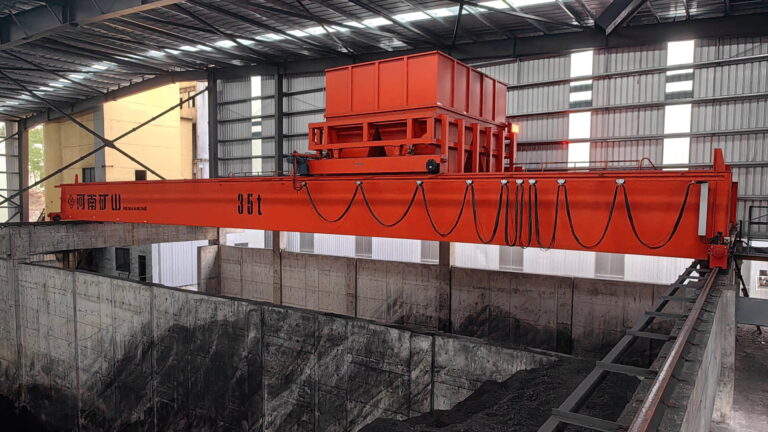
Purpose-built carbon block stacking crane installed inside a carbon-material baking workshop.
| Project LocationShandong carbon-material baking project | Crane StructureBox-type double girder + single trolley | Lifting SystemTwo rigid-guide block-handling devices | EnvironmentHigh dust and high temperature |
Project Background
Henan Mine Crane developed a carbon block stacking crane for a new carbon-material baking-furnace project in Shandong. The project crane uses a box-type double-girder structure, one trolley and two specialized lifting devices.
Carbon blocks must be picked, transferred and stacked closely and repeatedly around the baking process. Standard hooks are inefficient for this task because block geometry, stack density and production throughput require a lifting attachment that can align with and grip several blocks reliably.
The crane photographs display a 20t capacity marking. The project design combines dual rigid-guide lifting devices, stable clamping pressure, variable-frequency motion and a centralized protected electrical room for the dusty, high-temperature workshop.
Procurement priority: Send the carbon-block weight, dimensions, number of blocks per handling cycle, stack spacing, stack height and required cycle time. The lifting attachment and crane capacity must be selected as one material-handling system.
The Carbon Block Handling Challenge
Heavy carbon blocks need accurate pickup and placement to maintain organized, high-density stacks. Repeated manual alignment reduces production efficiency and places personnel close to suspended loads and process equipment.
A flexible rope-suspended attachment can swing or rotate while approaching tightly spaced blocks. The stacking crane therefore needs guided vertical movement and a clamping system that maintains reliable contact through lifting, travel and placement.
Dust and heat increase the reliability requirements for motors, brakes, electrical devices and cooling. Controls must remain protected while still allowing maintenance access for a crane expected to complete repetitive production cycles.
Carbon Block Stacking Crane Solution
Henan Mine Crane configured a box-type double-girder crane with a single trolley carrying two purpose-built carbon-block lifting devices. The rigid-guide arrangement controls attachment movement during pickup, transfer and placement.
Each lifting device can operate independently, or the two devices can work together. This gives the production team flexibility to handle different block quantities, stack patterns and transfer tasks.
Bridge travel, trolley travel and hoisting use variable-frequency speed control for smooth starting and reduced mechanical shock. The electrical system is centralized inside a dedicated room with industrial internal-circulation air conditioning.
Buyers can review the available double-girder overhead crane structures before defining the specialized lifting attachment and project environment.
20t Project Capacity and Load Definition
The referenced crane image shows a 20t rating. For a new carbon plant, the required crane capacity is calculated from the two lifting devices, the maximum number of blocks per cycle, attachment self-weight and any additional tooling.
The technical agreement should state the permitted load for one lifting device, the combined load when both devices operate together and any restrictions on simultaneous motion. Block weight variation is included in the load calculation.
Capacity alone does not define productivity. The crane proposal should also calculate blocks per hour from pickup, clamping, hoisting, travel, positioning, release and empty return.
Box-Type Double-Girder, Single-Trolley Structure
The project uses a box-type double-girder bridge with one trolley. The structure provides the rigidity needed for the large guided lifting frame while the trolley coordinates the two attachments.
A lightweight design concept reduces unnecessary crane dead weight and helps control wheel loads and workshop construction cost. The final design still needs to meet capacity, deflection, fatigue and repetitive-duty requirements.
The crane supplier provides wheel loads, horizontal loads, buffer forces and runway information for building coordination. Span, rail elevation, end approach and maintenance clearances are checked against the workshop drawing.
Dual Rigid-Guide Lifting Devices
The two lifting devices use rigid guide columns, multiple groups of rail-type guide wheels and high-strength wear-resistant guide tracks. This controls lateral attachment movement and improves alignment with closely stacked carbon blocks.
Guide-wheel arrangement, clearance and track wear influence attachment stability. The maintenance plan should include guide-wheel inspection, lubrication or material requirements, track condition and allowable clearance.
Rigid guidance also improves repeatability, but it requires the crane, attachment and stack coordinates to remain correctly aligned. Runway condition, bridge travel and trolley positioning therefore affect the complete handling system.

Full workshop view of the 20t double-girder crane and dual rigid-guide lifting system. |

Specialized attachment gripping multiple carbon blocks for controlled transfer and stacking. |
Independent or Linked Operation
Each lifting device can work separately when the task requires one attachment. The two devices can also operate together for a combined handling cycle.
The control logic should define mode selection, permitted loads, movement synchronization, clamping confirmation and operator indications. A deliberate mode-selection process prevents an independent command from conflicting with linked operation.
Acceptance testing can include single-device and dual-device cycles with representative block arrangements. The buyer can verify pickup, travel, placement and release in every contractually permitted operating mode.
Stable Clamping Pressure
The lifting system is designed to provide high and consistently maintained pressure for reliable carbon-block gripping. Stable clamping is important when the crane accelerates, travels and positions a group of blocks above the workshop.
The buyer should provide block surface condition, dimensional tolerance, weight variation and permitted contact locations. Attachment pads, contact pressure and clamping geometry are selected to hold the blocks without unacceptable damage.
Sensors and controls can confirm the attachment state before hoisting. The lifting sequence should prevent bridge or trolley travel until the required clamping condition is achieved.
VFD Smooth Motion and Three-in-One Drives
Bridge travel and hoisting use variable-frequency speed control. The integrated three-in-one drive system combines motor, reducer and brake functions for compact installation and coordinated operation.
Smooth starting reduces shock to the carbon blocks, lifting attachment, crane structure and workshop runway. Low-speed control supports accurate approach to pickup and stack positions.
The RFQ should state maximum speeds, minimum stable speeds, acceleration requirements and target cycle time. Drive performance can then be selected for production throughput without unnecessary load movement.
High-Dust and High-Temperature Electrical Protection
The project centralizes the electrical control system in a dedicated electrical room. Industrial internal-circulation air conditioning protects the controls from dusty, hot process conditions.
A new-project quotation should use measured or specified ambient temperature, radiant heat, dust type and dust concentration. Enclosure, cooling, filtration, cable routing and component selection are matched to these conditions.
Internal circulation reduces direct exchange with the workshop atmosphere, but cooling capacity, alarm limits and maintenance access still require definition. The system should indicate abnormal temperature or cooling failure before control equipment is damaged.
Safety Limits, Emergency Control and Monitoring
The crane integrates safety limits, emergency electrical switches, alarms and safety-monitoring devices. Protection covers repetitive handling around carbon-block stacks and baking equipment.
The technical agreement should list upper and lower limits, travel limits, overload protection, clamping permissives, emergency stops and alarm behavior. Safety zones and prohibited travel areas are coordinated with the workshop layout.
Monitoring information should help the operator identify load state, attachment mode, clamping confirmation, mechanism condition and active alarms. Fault response and restart authorization are defined for every production-critical function.
Automation Scope for Carbon Block Warehouses
The crane uses intelligent and variable-frequency control. Complete unmanned warehouse operation is not confirmed for this project. Buyers requiring automatic stacking should define the additional scope separately.
An automated project needs stack coordinates, block identification, position feedback, pile inventory, collision zones, automatic route logic and interfaces with the plant production system.
Manual takeover, maintenance zones, communication-loss behavior and recovery from an incomplete stacking cycle must also be included. Automation level is then selected from production volume and return on investment rather than assumed from the lifting attachment.
Key Project Configuration
| Project Element | Referenced Configuration and Buyer Value |
|---|---|
| Project | New carbon-material baking-furnace project in Shandong. |
| Visible Capacity | 20t marking shown on the project crane. |
| Crane Structure | Lightweight box-type double girder with one trolley. |
| Lifting Devices | Two rigid-guide carbon-block attachments with guide wheels and wear-resistant tracks. |
| Operating Modes | Independent operation or linked operation of the two lifting devices. |
| Motion Control | Variable-frequency bridge, trolley and hoisting control with three-in-one drives. |
| Electrical Protection | Centralized electrical room with industrial internal-circulation air conditioning. |
| Safety | Limits, emergency electrical switches, alarms and safety monitoring. |
Project Result
The specialized crane gives the Shandong baking project a purpose-built system for picking, transferring and stacking multiple carbon blocks.
Dual rigid-guide lifting devices improve attachment stability and can operate independently or together. Stable clamping pressure supports reliable block handling through the complete production cycle.
VFD motion reduces impact on the blocks, crane and workshop, while the centralized air-conditioned electrical room protects controls from dust and heat. Integrated safety limits, alarms and monitoring support long-term production duty.
Information Required for a Carbon Block Stacking Crane Quote
Send the following information so Henan Mine Crane can prepare a project-specific technical proposal and commercial quotation:
| Carbon Blocks Weight, dimensions, tolerances, surface condition, number per lift, contact restrictions and maximum combined load |
Stack Layout Rows, spacing, stack height, pickup and placement coordinates, storage capacity and access clearance |
Crane Geometry Span, runway length, rail elevation, lifting height, hook approaches, building clearances and allowable loads |
| Production Cycle Required blocks per hour, travel distance, operating hours, duty, independent or linked operation and target speeds |
Environment Dust type and concentration, ambient and radiant temperature, ventilation, cleaning and electrical-room conditions |
Project Scope Automation, testing, transport, erection, commissioning, training, spares, warranty and lifecycle service |
A maintenance plan can be prepared with the overhead crane preventive maintenance checklist.
Frequently Asked Questions
What capacity is shown on the project crane?
The project crane displays a 20t marking. A new crane’s capacity must include attachment weight and the maximum carbon-block load.
Why use rigid guide columns?
Rigid guide columns, guide wheels and wear-resistant tracks control unwanted attachment movement and improve alignment with closely stacked blocks.
Can the two lifting devices operate separately?
Yes. The project devices can work independently or operate together for different block-handling and stacking tasks.
How are the electrical controls protected?
The controls are centralized in a dedicated electrical room with industrial internal-circulation air conditioning for the dusty, high-temperature environment.
Is the referenced crane fully automatic?
This project uses intelligent and VFD control. Complete unmanned warehouse operation is not confirmed for this case. Full automation can be engineered separately from stack coordinates, inventory and process interfaces.
What data is required before pricing?
Provide block weights and dimensions, blocks per lift, stack layout, workshop drawing, cycle time, duty, dust and temperature, control mode and project scope.
Request a Carbon Block Stacking Crane Quote
Send your carbon-block data, stack layout, workshop drawing, production cycle, dust and temperature conditions. Henan Mine Crane will prepare a purpose-built stacking crane proposal and commercial quotation.